
UNESCO World Heritage Sites in Belarus
There are four UNESCO World Heritage sites in Belarus: the Mir Castle Complex, the Radziwiłł residence at Nesvizh, Białowieża Forest and the points of the Struve Geodetic Arc. The first two are architectural masterpieces, the third is an ancient forest and the fourth is a monument to 19th-century science.
This page brings together the UNESCO sites in our catalog with a map and descriptions. Below you will find a short history of each site, tips for seeing them all in two or three trips, and how World Heritage differs from other UNESCO lists.
Places found: 8


 3
 2900







World Heritage sites in Belarus
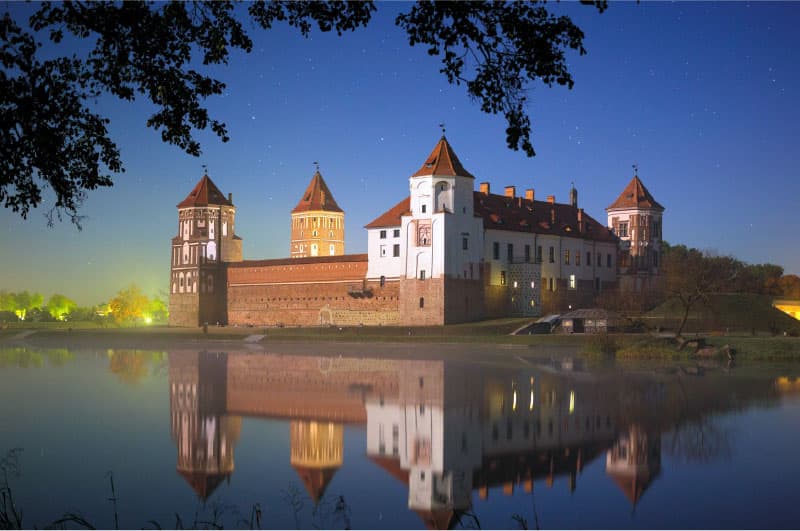
- Mir Castle Complex (inscribed in 2000). Construction began in the early 16th century under the Ilyinich family, and from the second half of that century the castle belonged to the Radziwiłłs. Gothic, Renaissance and Baroque features blend in its design. Today it houses a museum.
- Architectural, Residential and Cultural Complex of the Radziwiłł Family at Nesvizh (2005). It includes the palace surrounded by parks and ponds, and the late 16th-century Corpus Christi Church, one of the first Baroque buildings in Eastern Europe.
- Białowieża Forest. Originally only the Polish part was listed; in 1992 the site was extended to Belarusian territory. It is one of the last large areas of primeval lowland forest in Europe and home to European bison.
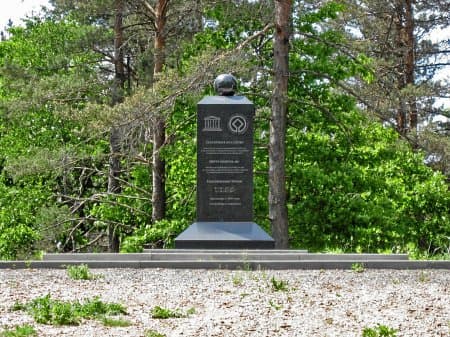
- Struve Geodetic Arc (2005) - a chain of survey triangulation points created in the 19th century to measure the size and shape of the Earth, shared by ten countries.
Beyond the castles in Mir and Nesvizh
In Mir, after the castle museum, walk through the park to the early 20th-century Svyatopolk-Mirsky burial chapel, then explore the small town itself, with its Holy Trinity Church, market square and the building of the famous Mir Yeshiva. In Nesvizh, besides the palace, visit the Corpus Christi Church with the Radziwiłł family crypt, the town hall - one of the oldest in Belarus - and the Slutsk Gate, a surviving gateway of the old town fortifications.
The Struve Arc in Belarus
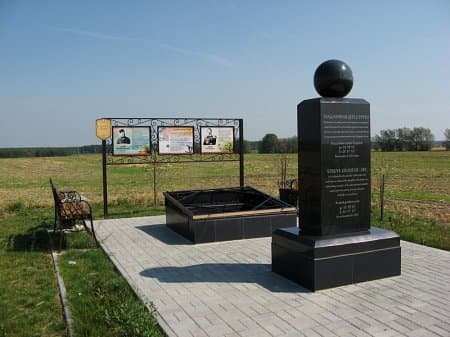
The arc was measured between 1816 and 1855 under the astronomer Friedrich Georg Wilhelm Struve. The chain stretched for more than 2,800 km, from the coast of Norway to the Black Sea. UNESCO lists 34 surviving points, five of them in Belarus, in the Grodno and Brest regions. Each is marked by a memorial sign.
Our catalog includes the Struve Arc point ‘Ivatsevichi’, a good introduction to this unusual site. The point itself is modest, so it is best visited as part of a wider route through the Brest Region.
How to see all the UNESCO sites
- Mir and Nesvizh in one day. This is the classic trip from Minsk, as the two castles are close to each other. To take it slowly, stay overnight in Mir or Nesvizh.
- Białowieża Forest and Brest. Give the forest at least a full day: the nature museum, bison enclosures, nature trails and cycling routes. In winter many families visit Father Frost’s estate inside the park.
- Struve Arc points. These are easiest to visit on the way, for example when driving from Minsk to Brest or touring the Grodno Region.
Tentative list and intangible heritage
Besides World Heritage, UNESCO maintains other lists. Belarus’s Tentative List includes sites the country is considering for future nomination, such as the Augustów Canal. Being on it does not mean World Heritage status.
UNESCO’s Intangible Cultural Heritage lists include the Kalyady Tsars rite in the village of Semezhava and the Budslav feast honouring the icon of the Mother of God. The Berezinsky Reserve, meanwhile, is a UNESCO Biosphere Reserve, which is a separate conservation programme.
Frequently asked questions
How many UNESCO World Heritage sites are there in Belarus?
Four: the Mir Castle Complex, the Radziwiłł complex at Nesvizh, Białowieża Forest (shared with Poland) and the Struve Geodetic Arc (shared with nine other countries).
Can I visit Mir and Nesvizh in one day?
Yes. The castles are close to each other, and this is one of the most popular day trips from Minsk.
Where are the Struve Arc points in Belarus?
The five UNESCO-listed points in Belarus are in the Grodno and Brest regions. Each is marked by a memorial sign.
Is Brest Fortress a UNESCO site?
No. Brest Fortress is not a World Heritage site, although it is one of the most visited memorials in the country.
What is the UNESCO Tentative List?
It is a list of sites a country intends to nominate in the future. Inclusion does not grant World Heritage status.
Other collections
- Minsk Region
- Brest Region
- Grodno Region
- Vitebsk Region
- Mogilev Region
- Gomel Region
- Minsk
- Grodno
- Brest
- Vitebsk
- Polotsk
- Gomel
- Mogilev
- Castles & Palaces
- Churches
- Manor Houses
- Museums
- Memorials
- Nature
- Archaeology
- With Kids
- Ruins