
Bezdezh. The Struve Geodetic Arc.
Landmark
Brest region, Drogichinsky district, Bezdezh agro-town
-1773053847550.webp&w=3840&q=75)
-1773053847651.webp&w=3840&q=75)
-1773053847639.webp&w=3840&q=75)
-1773053847627.webp&w=3840&q=75)
-1773053847584.webp&w=3840&q=75)
-1773053847604.webp&w=3840&q=75)
-1773053847967.webp&w=3840&q=75)
-1773053857756.webp&w=3840&q=75)
Description
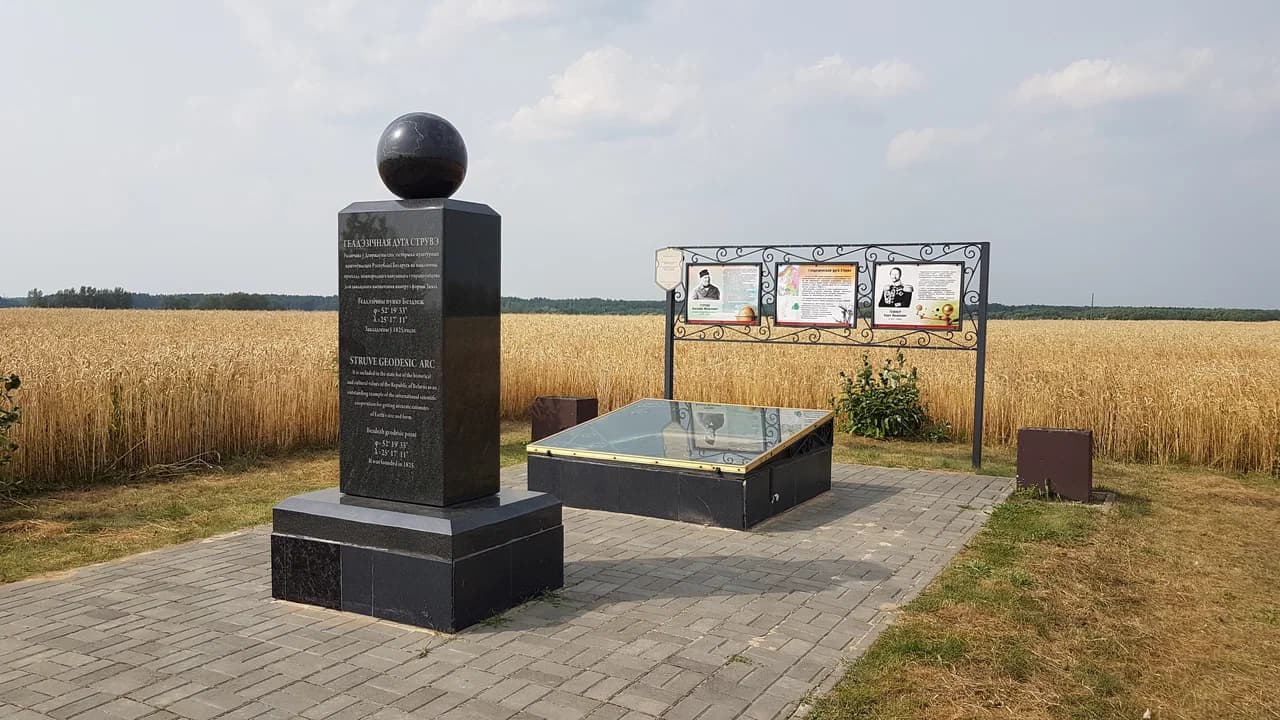
The Struve Geodetic Arc is a grandiose scientific project of the 19th century to measure the shape of the Earth, stretching for 2,820 km from Norway to the Black Sea. 19 sites of this UNESCO site have been preserved in Belarus. One of them is located near the agricultural town of Bezdezh in the Brest region. There is a memorial sign here, and under the glass you can see the original stone cube from 1825. Nearby is the "Bezdezhsky Apron" Museum and a unique black birch tree. A place where the history of science meets the culture of Polesie.
Categories

Historical

UNESCO
Comments
Reviews to the Place
1Ольга Ерёменко
09.03.2026
The trace of the Great Experiment in the Polesie hinterland: Bezdezh and the Struve Arc
At first glance, the agro-town of Bezdezh in the Drogichin district is a typical corner of the Belarusian Polesie. It is famous for its wooden Trinity Church built in 1784, the unique museum "Bezdezhsky apron" and even a rare black birch. But there is a place here that takes this location out of its local context and fits it into the history of world science. On the eastern outskirts of Bezdezh, near the road to Khomsk, there is one of the key points of the famous Struve Geodetic Arc.
The Struve Arc is a grandiose scientific project of the first half of the 19th century, a unique monument of the intellectual history of mankind, included in the UNESCO World Heritage List. For almost 40 years, a network of 265 geodetic points has been created under the leadership of the outstanding astronomer Vasily Yakovlevich Struve. Scientists were solving an ambitious task: to measure the parameters of the Earth with the highest accuracy - its shape and size.
The measurement chain stretches for 2,820 kilometers - from the coast of the Arctic Ocean in Norway to the mouth of the Danube in Ukraine. Today, only 34 of the 265 sites have been preserved, and Belarus has a special role in this list. Our territory has the largest number of surviving signs - 19 out of 34, and five of them have the status of UNESCO protected sites. Three such points are located in the Brest region, and one of them is Bezdezh.
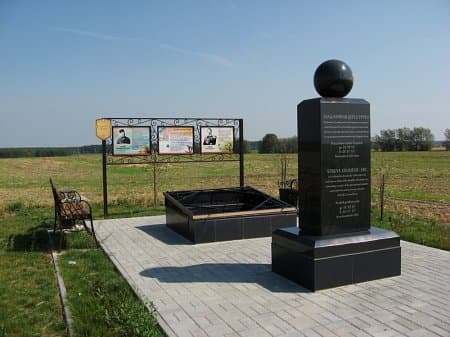
Approaching the memorial, it is difficult not to feel respect for the scale of thought. In 1825, when neither satellites nor precision computers existed, surveyors laid a two-meter stone cube in the local land. Today, a modern memorial sign has been erected on this hill - a black granite pedestal with a ball symbolizing the planet, the outlines of Belarus and a brief explanatory inscription. But the most interesting thing is hidden underground. There is a special "well" with an observation window nearby. Through the glass, you can see the original point from 1825: a brick pillar topped with a stone carved with the letter "T" (in honor of Struve's colleague, the surveyor Karl Tanner) and the numbers "1825".
This place is equipped for visitors: paths have been laid, benches and information stands have been installed, telling about the titanic work of scientists who "calculated" the size of our planet more than a century and a half ago.
A visit to the Bezdezh point can easily be turned into an eventful excursion. After getting acquainted with the history of geodesy, it is worth visiting the agro-town itself. There, in the famous "Bezdezhsky Apron" museum, you can see a collection of more than 300 elegant aprons, authentic costumes and even try yourself as a weaver. And in front of the Struve Arc memorial there is another local landmark - a black (or Daurian) birch, rare for Belarus, marked with a memorial stone.
The Bezdezh point of the Struve Arc is a wonderful example of how the history of high science can be integrated into the cultural landscape of an ordinary village, reminding us of the grandiose achievements of the past.