Знай свой край

Знай свой край

Self-Guided Tours of Minsk Region

Self-guided tours of Minsk Region on my-places.by are ready-made routes that authors have put together from places in our catalog. Each route comes with a map, the order of stops and an approximate length, so you can follow it on your own, at your own pace, without joining a group.

The region surrounds the capital on all sides, and most trips here fit into a single day: leave Minsk in the morning, be back by evening. Below are the routes from the catalog, followed by tips on planning a good day trip or weekend.

Excursions found: 110

On the memorable places of Yanka Kupala.

Embark on a journey through the memorable places of Yanka Kupala! Yanka Kupala is one of the most famous classics of Belarusian literature. His life and work are closely connected with different parts of Belarus, where today you can see museums, manors and memorable places that preserve the memory of the poet. In the village of Yakhimovshchina there is a museum dedicated to the early period of the poet's life. Here he lived and created his first works. The museum is located in a 19th-century manor house, where Kupala's house and a picturesque park have been preserved. The exhibition tells about his work in the Belarusian press and the creation of the famous collection "Zhaleika". Yanka Kupala was born in Vyazynka in 1882. The memorial hut recreates the atmosphere of the poet's childhood: a stove, furniture, and personal belongings of the family. Of particular interest is the "singing chest" with its songs. In Radoshkovichi Kupala was baptized in the Church of the Holy Trinity. Here he worked as a clerk in 1904-1906, and under the influence of the local intelligentsia began to write in the Belarusian language. A branch of the literary museum, the Okopy, is located in the village of Khoruzhintsy. Kupala drew inspiration for his works here. The recreated 19th-century house with the sculpture "Young Kupala" transport visitors to that era. Yanka Kupala's main Literary Museum is located in the capital, where his manuscripts, personal belongings and photographs are kept. You can also visit the Military Cemetery in Minsk, where the poet is buried, and the building of the former men's theological college, where he worked in the Educational Institution. There is a memorial reserve in the village of Levki, where the poet's summer cottage was located from 1935 to 1941. Here he wrote his works, and today you can see his personal belongings. In the village of Plamya (Flame) Kupala worked as a housekeeper. Ruins have remained of the once magnificent estate. ...

Driving | 12 locations

By region

By region

Likes2

Views2613

Minsk (walking route 3). Troitskoe suburb and surroundings.

This tour covers the iconic sights located in the heart of the capital. Let's start the journey from the Troitskoe (Trinity) suburb. We will stroll through the picturesque quarter with cozy streets, stylized houses with tiled roofs. Here we will visit the original iron museum, the Maxim Bogdanovich Literary Museum, and also get acquainted with the famous Vigdorchik house, which today houses the 'Famous Masters' private gallery. We will visit the touching memorial "Island of Tears" dedicated to the internationalist soldiers who died outside Belarus, including in Afghanistan. A place of mourning and memory that makes you think about the value of peace. Next, we will go to the Alivaria Brewing Museum, where we will learn the history of Belarusian beer, the secrets of its production and will be able to taste various varieties. Let's immerse ourselves in the atmosphere of Soviet Minsk by walking through Osmolovka quarter, a unique architectural ensemble that has preserved the spirit of the 50s. Then we will admire the majestic building of the National Academic Opera and Ballet Great Theater, the pride of Belarusian culture. We will take a walk through the picturesque Kupala Park, enjoying the silence and beauty of nature in the very center of the city. We will conclude our tour by diving into the world of Belarusian literature by visiting the Yanka Kupala Literary Museum, which has become not just a repository of information, but also an important center that explores and interprets the legacy of Yanka Kupala. ...

Walking | 11 locations

Overview

Overview

Likes2

Views1861

We explore the sights of Belarus using local money.

The sights of Belarus on banknotes: from the Kamenets Tower to the National Library. Belarusian money is decorated with images of iconic landmarks located in different regions of the country. These objects reflect the rich history and culture of Belarus. 5 rubles – Kamenets Tower (or Belaya Vezha, means 'White Tower'). This tower, built in 1288, is one of the oldest monuments in Belarus. It is located in the city of Kamenets (Brest region). The height of the structure is 31 meters, and the wall thickness reaches 2.5 meters. The tower has withstood many sieges, and today it is one of the symbols of the country. 10 rubles – Transfiguration Church in Polotsk. The 12th-century temple, founded by St. Euphrosyne of Polotsk, is a rare example of ancient Polotsk architecture. Unique frescoes have been preserved inside, and the temple itself claims to be included in the UNESCO list. 20 rubles – The Rumyantsev-Paskevich Palace in Gomel. A luxurious palace and park ensemble in the classical style. The palace belonged to the noble families of Rumyantsev and Paskevich, and today there is a museum with a rich collection of works of art. 50 rubles – Mir castle. UNESCO World Heritage Site, built in the 16th century. The castle combines features of Gothic and Renaissance architecture, and its powerful towers and brick walls make it one of the most impressive buildings in Belarus. 100 rubles – Nesvizh castle. Another UNESCO site is the residence of the Radziwill family. The castle, built in the 16th century, is famous for its magnificent architecture and picturesque park. 200 rubles – Mogilev Art Museum. The museum building, built in the early 20th century, combines the features of Art Nouveau and classicism. Works of art, including works by Belarusian masters, are kept here. 500 rubles – The National Library in Minsk. The modern symbol of Belarus is in the shape of a diamond. Holds about 10 million books, there are viewing platforms with panoramic views on the upper floors. ...

Driving | 12 locations

By region

By region

Likes2

Views1850

On the memorable places of Yakub Kolas.

Yakub Kolas is one of the most revered classics of Belarusian literature, poet, novelist and public figure. His legacy is inextricably linked with the history and culture of Belarus. We suggest you go on an exciting journey to the places where this outstanding writer lived, created and left his mark. Minsk. The Literary Memorial Museum dedicated to the life and work of Yakub Kolas is located in the house where he lived from 1952 to 1956. There are more than 32,000 exhibits here: manuscripts, personal belongings, books, and even audio recordings of the poet's voice. The exhibition includes 10 halls recreating the interiors of his office and family life. Minsk. The military cemetery where Yakub Kolas himself is buried. There are also graves of other prominent figures of Belarus here. Minsk. Yakub Kolas Square. One of the most beautiful squares in the capital is decorated with a monument to the poet and sculptures of his literary heroes. In 1956, the square was named after Kolas, and in 1972, a monument was erected here. Minsk. Pishchalovsky castle. In this historic 19th-century prison, Kolas served his sentence for participating in the revolutionary movement. The complex "Shlyakh Kolasa" (The way of Kolas) in Nikolaevshchina. This open-air museum unites four manors associated with the writer's life: Akinchitsy (place of birth), Lastok (childhood), Albut (youth) and Smolnya (adulthood). The monument in Novogrudok is located near the bus station and is part of a tourist route connecting places associated with Yakub Kolas and Adam Mickiewicz. Museums in Gantsevichi and Pinkovichi. Kolas worked as a teacher in these cities, and today his memory is preserved here. Luninets Museum of Local Lore. The exhibition tells about the period when Kolas lived in Luninets (1911-1912). This route will allow you to better understand the work of Yakub Kolas, see the places where he drew inspiration, and feel the spirit of the era in which he lived. ...

Driving | 14 locations

By region

By region

Likes2

Views1686

Minsk. Elements of nature.

This trip is not just a walk around the city, but a whole day (and possibly two) of inspiration, peace and unexpected discoveries. The tour covers various corners of Minsk: from picturesque parks and botanical gardens to interactive museums and cozy squares, where history comes to life and nature flourishes. The day will begin at the Minsk Zoo, where dolphins, dinosaurs and friendly raccoons are waiting for you. Next, the route will lead to the 900th Anniversary of Minsk Park, a spacious recreational area near the Chizhovsky reservoir with bike paths and a health trail. In the Loshitsky Estate and Park Complex, history meets the greenery of centuries-old trees, and the nearby Chingiz Aitmatov Park is a great place for family recreation and walks. At the Oceanography Center, you can hold a spacesuit, ring the bell, and talk to Flint the parrot. Afterwards, guests can relax in the Mickiewicz, Mikhailovsky and Alexandrovsky squares, each of which is filled with sculptural charm, fountains and cozy silence. The historical depth will be revealed in the Victory Museum and Park complex, and the solitude of the Island of Birds will allow you to hear hundreds of voices of winged inhabitants. In the second part of the route, participants will immerse themselves in the landscape masterpieces of the Drozdy and Friendship of Peoples parks, relax in the Botanical Garden among lilacs and palm trees, experience adrenaline on the trails of Chelyuskintsev Park, then visit Yanka Kupala Park, where poetry and landscape merge into one beautiful composition. The final chord will be a walk through the Maxim Gorky Central Children's Park, one of the oldest parks in Belarus, founded back in 1805. This tour is an ideal way to explore Minsk from a different perspective: natural, cultural and inspiring. From colorful animals to ancient farmsteads, from the shade of lime trees to sunny embankments, everyone will find their favorite corner. ...

Driving | 16 locations

Overview

Overview

Likes2

Views1660

Mystical places of Belarus.

Belarus is a country with an ancient history full of mystical mysteries. The tranquil scenery hides a world of ghosts, curses, and unexplained phenomena. The route starts in Brest region, in the village of Pare, nicknamed the "village of vampires". According to legends, unique funeral rites with oak rolls, boulders and aspen stakes kept the deceased in the world of the dead, preventing them from becoming ghouls. The Grodno region is the heart of Belarusian mysticism. Here, the ruins of the Kossovo Castle inspired Korotkevich's "King Stakh". The ghosts of warriors roam the castle of Lida, and a White Lady and a Black Monk live in Golshany. The ghost of a walled-up wife still haunts the castle of Krevo. In the center of the country, Nesvizh Castle is guarded by the ghost of the Black Lady, Barbara Radziwill. There is an Egyptian pyramid in Uzda, a tomb for magical rituals, and in Nalibokskaya Pushcha there is an estate with the ghost of a walled-up maid. The lakes also hide secrets. According to legend, a city stood on the site of Lake Svityaz, and now its mermaids lure travelers. The Dead lake is devoid of life, and its silence and the smell of hydrogen sulfide are terrifying. Even Minsk is not devoid of mysticism: at the Monastyrsky Hotel, guests are greeted by the ghost of a monk, and the soul of the executed noble Volodkovich wanders by the Town Hall. These places are just a part of the mystical heritage. Their legends are worth exploring personally in order to touch the mysterious spirit of Belarusian history. ...

Driving | 17 locations

By region

By region

Likes2

Views1647

Iconic places to explore the nature of Belarus.

Belarus is a country with a surprisingly diverse and picturesque nature, where each region is ready to reveal its unique secrets. This is an ideal destination for those who want to take a break from the hustle and bustle of the city and immerse themselves in the world of untouched landscapes, ancient forests and crystal clear lakes. You can start your journey through the natural pearls of the country from the Vitebsk region, the edge of lakes and swamps. Here you will find large-scale wetlands, such as the Yelnya and Kozyansky nature reserves, where you can observe the life of rare birds from the wooden decks of the ecotrope. No less impressive are the Braslav lakes, including the perfectly round "God's Eye" and Lake Nedrovo, whose shores preserve traces of ancient settlements. And from Mount Mayak there is a panorama that is rightfully considered one of the best in the country. Minsk region attracts tourists with its main resort area, Naroch region, where the largest lake in Belarus is located. The 'Blue Lakes' ecotrope runs nearby, the route of which resembles the landscapes of Switzerland. And for lovers of truly wild nature, Nalibokskaya Pushcha is the largest forest area inhabited by bison and brown bears. In the west of the country, in the Grodno region, you can go rafting on the winding Shchara River in Lipichanskaya Pushcha or see the unusual "Belarusian Maldives" — chalk quarries near Volkovysk with emerald-colored water. The legendary Belovezhskaya Pushcha in Brest region is the last relict primeval forest in Europe, the kingdom of powerful bison. And in spring, in Tyshkovichi, you can get to the tulip festival, comparable to the Dutch one. The Gomel region surprises with its contrasts: from the spring "Sea of Herodotus" in Pripyatsky National Park to the man-made "fjords" in Glushkovichi and soothing lavender fields. Mogilev region is famous for holy springs, like the Blue Spring, and extensive nature reserves like the "Duleba Islands." ...

Driving | 26 locations

By region

By region

Likes2

Views1386

Minsk. New facets of the capital (route 2).

We are going on an exciting journey through Minsk, which will cover the most diverse facets of the city. Our route will allow you to discover not only famous sights, but also nooks that preserve the history and culture of Belarus. The first stop is the Museum of Aviation Technology, where we will immerse ourselves in the world of aviation. Next, we will go to the Boulder Museum, a unique open-air museum with huge boulders brought from all over Belarus. Next stop is the Eastern cemetery, where prominent figures of Belarus - scientists, writers, artists, and politicians – have found their last resting place. It is a place of memory and peace. We will see the All Saints Church, a modern and majestic memorial church. At the 'Nose' Museum of Smells, we will explore the world of smells and learn about the influence of scents on our lives. We will make a stop at the National Library. It is the architectural dominant of Minsk and the largest repository of knowledge in Belarus. Admire the unusual diamond-shaped building and learn about the country's rich book heritage. Let's plunge into the atmosphere of the 19th century by visiting the ancient Vankovich estate, which belonged to this famous Belarusian family. Take a walk through the Central Botanical Garden. It is an oasis of greenery in the city center, where thousands of plant species from all over the world are collected. Let's immerse ourselves in the world of Belarusian literature by visiting the memorial museum of one of the most famous Belarusian writers, Y. Kolas. We will visit the oldest Chelyuskintsev Park of Culture and recreation, as well as the Peoples' Friendship Green Park. We'll see the only functioning St. Elizabeth Convent in the city, as well as the Church of the Intercession of the Blessed Virgin Mary. Take a walk through the picturesque Drozdy Park. This tour is an approximate route that can be adapted to suit your interests by adding or removing some objects. Discover new facets of Minsk! ...

Driving | 14 locations

Overview

Overview

Likes2

Views1320

On the memorable places of Yazep Drozdovich.

Embark on a journey through the memorable places of Yazep Drozdovich! Yazep Drozdovich (1888-1954) was an outstanding Belarusian artist, sculptor, writer and ethnographer, whose work became a symbol of national revival. This tour will take you through places related to his life and legacy, revealing the versatility of his talent. 1. Germanovichi Museum of Culture and Everyday Life. The 18th–century manor in Germanovichi houses 14 original works by Drozdovich, from graphics to fantastic landscapes, in which science, mythology and art are intertwined. The museum offers not only to see masterpieces, but also to participate in master classes, immersing itself in the world of the artist. 2. The grave in Liplyany. Drozdovich's tragic fate ended in 1954. A memorial stone with a bas-relief has been erected in the village of Liplany, reminding of the man who captured the beauty of Belarus in "malyavany dyvany" (hand-drawn carpets) and architectural sketches. 3. Glubokoe Historical and Ethnographic Museum. Drozdovich's works are collected here, reflecting the national flavor. The museum recreates the atmosphere of the era, and the artist's paintings reveal his philosophical view of tradition and mythology. 4. Malyavanka Museum in Zaslavl. Drozdovich is one of the most outstanding masters of this folk art. The museum houses his vivid works on canvases and burlap depicting mythical creatures and traditional ornaments, here is the largest collection in the country. 5. A monument dedicated to Yazep Drozdovich stands on Troitskaya Embankment in Minsk. The monument reflects not only the portrait similarity, but also the artist's worldview. 6. The Belarusian gymnasium in Novogrudok. In the 1920s, Drozdovich taught here, educating a new generation in the spirit of Belarusian culture. This is a journey in the footsteps of a genius whose work combined art, science and love for his native land. From Germanovich to Novogrudok, each object reveals a new facet of its heritage. ...

Driving | 6 locations

By region

By region

Likes2

Views1194

Minsk. New facets of the capital (route 1).

This tour will take you through contrasting pages of Minsk's history and modernity, from places of mourning and memory to picturesque parks, modern entertainment and street art. We will touch upon the tragic events of the Second World War, learn about the life of the Belarusian gentry, admire the diversity of wildlife and immerse ourselves in the atmosphere of a modern city. The first stop is the Trostenets Memorial Complex, the largest death camp in Belarus. Not far from Trostenets we will visit the Church of St. John the Baptist, a modern majestic temple. Later, we will go to the Minsk Zoo, an island of wildlife in the city center, where we will walk through the themed areas, observe the life of animals and relax in the fresh air. We will visit Loshitsky Park, one of the most picturesque places in Minsk, shrouded in legends and stories. In the Loshitsa Manor museum, we will get acquainted with the history of the estate, see household items and art reflecting the life of the gentry. On the way to the next points of the route, we will make a short stop at the Adadurov Estate, known as the "White Cottage". It is an architectural monument of the 19th century, which belonged to a famous Minsk family. Fast forward from the past to the present and go to the Open Ocean, a unique oceanography center where you can see exotic marine life and immerse yourself in the amazing underwater world. At the Museum of the History of Medicine of Belarus, we will trace the path of development of medicine in the Belarusian lands. We will visit the Belarusian Hut Museum, dedicated to the life and work of the Belarusian poet and writer Maxim Bogdanovich. We will finish our tour on Oktyabrskaya Street, the heart of modern, creative Minsk. This tour is an approximate route that can be adapted to suit your interests by adding or removing some objects. Discover new facets of Minsk! ...

Driving | 10 locations

Overview

Overview

Likes2

Views1162

Ideas for autumn travel in Belarus.

Golden Autumn in Belarus: where to go for unforgettable impressions? Autumn is the perfect time to rediscover Belarus. The summer heat is gone, and crowded places in summer are plunged into a peaceful silence wrapped in gold and crimson. It's time for leisurely walks, deep immersion in history and contemplation of the most picturesque season of the year. We have collected the key destinations for the perfect autumn trip. Start with the natural treasures. The Berezinsky Biosphere Reserve looks like a jewel box in autumn: the forest turns into a multicolored carpet, where hiking and cycling routes through gilded forests and against the background of an ancient water system give a feeling of complete unity with nature. For connoisseurs of history, autumn reveals the true charm of Belarusian castles. The parks of the Mir and Nesvizh castles, UNESCO sites, are painted in romantic tones, creating a unique atmosphere for walking. Less famous, but not beautiful, are the palace in Zhilichi and the estate in Krasny Bereg, whose interiors and autumn parks make an indelible impression. Looking for privacy? Go to Nalibokskaya Pushcha, where you can watch the autumn migration of birds and the splendor of nature. Cities are also being transformed. Grodno, with its cobbled streets and majestic castles above the Neman River, is becoming especially atmospheric. And in Minsk, the Botanical Garden and the Troitskoe suburb are especially cozy. We also recommend visiting one of the autumn festivals, for example, the festival of folk crafts "Slutsk payasy" (Slutsk belts) in Slutsk, the harvest festival "Bagach" (Rich man) in Vyazynka or the international organ music festival "Zvany Safii" (Sophia bells) in Polotsk. Autumn in Belarus is not an off-season, but a real must-have for those who are looking for beauty, silence and inspiration. ...

Driving | 13 locations

By region

By region

Likes2

Views1122

How the routes work

Every tour in the catalog is a chain of specific places: castles, manor houses, churches, memorials and natural sights. The author sets the order of stops, and the site plots the way along real roads and shows it on a map. You can see at a glance how many stops there are and whether the route is meant for driving or walking. A ready-made route is a good starting point: skip a stop that doesn’t interest you or add a break where you like.

In Minsk Region a route is almost always a ‘spoke’ from the capital: out along one highway, a few stops, back the same way or along a neighbouring road. So the first thing to choose is the direction, not the distance.

Day trips from Minsk

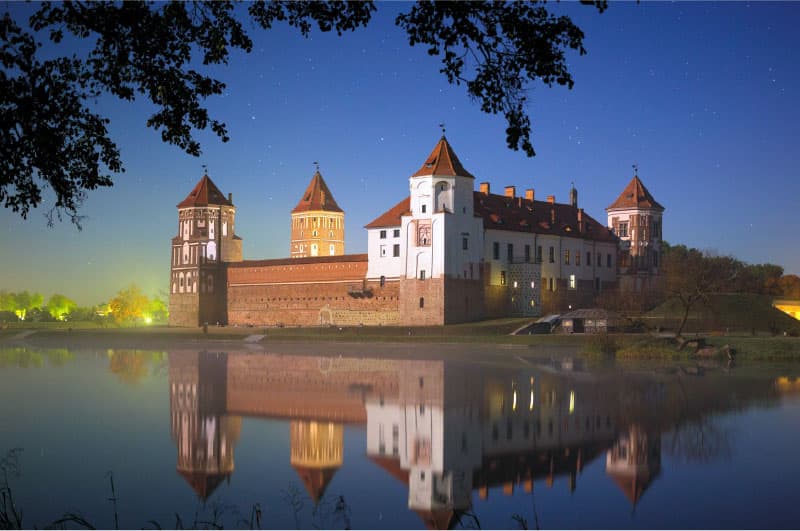
  • Nesvizh and Mir. The best-known pairing: the Radziwiłł palace and park ensemble in Nesvizh and Mir Castle, both UNESCO World Heritage Sites. Strictly speaking, Mir lies in Grodno Region, but from Minsk the two are almost always combined in one trip.
  • Zaslavl and the Stalin Line. A half-day route: ancient Zaslavl with its 16th-century Church of the Transfiguration and the military history complex nearby. A good choice if you set off after lunch.
  • Borisov and the Berezina. The catalog has a walking tour of Borisov, one of the oldest towns in the country. It is easy to add the Brilevo field, where Napoleon’s army crossed the Berezina in 1812.
  • Smilovichi. A driving route to the birthplace of the painter Chaïm Soutine takes you through small towns between Minsk and Berezino, including Smilovichi, where the Vankovich manor still stands.
  • Khatyn and the Logoisk area. The Khatyn memorial complex and the hilly countryside around Logoisk - a route that feels completely different in winter and summer.

A weekend route

With two days, head north to Lake Naroch, the largest lake in Belarus. Day one: drive via Vileika with a stop at the Vileika reservoir and spend the evening on the lakeshore. Day two: Budslav with its basilica, a pilgrimage site in summer, then the Myastro and Batorino lakes, returning to Minsk via Molodechno.

Another option is the south-west: Dzerzhinsk, near Dzerzhinskaya Hill, the highest point in Belarus, and Stankovo with the Czapski manor on the first day, then a slow walk around the park in Nesvizh on the second.

Roads and seasons

The Brest highway leads to Nesvizh and Mir, the Vilnius highway to Molodechno and on towards Naroch, and the Moscow highway to Borisov. Smaller manors and churches tend to sit away from the main roads, so allow time not only for driving but also for parking and short walks from the car to each sight.

The most comfortable season is May to October, when parks are open, summer cafés are running and the lakes are warm enough for swimming. In winter the days are short, so pick routes with two or three stops and museums rather than ruins in open fields. Always check museum and castle opening hours before you set off.

What to combine with a route

A day trip is easy to stretch with a night at a farmstead guesthouse - there are plenty around Naroch, Nesvizh and Logoisk. Travelling with children, you can add an open-air museum or a zoo to any direction, and in summer a beach on the Minsk Sea or the Vileika reservoir. And after you get back, finish the day with a walk around Minsk - the catalog has city routes too.

Frequently asked questions

What can I see in Minsk Region in one day by car?

The most popular options are Nesvizh and Mir, Zaslavl with the Stalin Line, Borisov with the Brilevo field, or the Khatyn memorial. Each fits into a day trip with a return to Minsk.

Are these guided tours?

No. The site offers ready-made routes with a map and descriptions of the places, put together by authors. You follow them on your own, whenever and at whatever pace suits you.

Can I reach these places without a car?

Buses and local trains run to Nesvizh, Borisov, Zaslavl and Molodechno, so parts of some routes can be done on foot from the station. Routes linking several village manors are much easier by car.

Where should I go in Minsk Region for a weekend?

Two days work well for the Naroch lakes with Budslav, or for the south-west of the region - Dzerzhinsk, Stankovo and Nesvizh with a night at a farmstead.

When is the best time for a trip around Minsk Region?

May to October is easiest, with open parks and long daylight. In winter choose shorter routes with museums and check opening hours in advance.

Other collections

All excursion collections