
Zaslavl. The Zamechek settlement.
Monument of archeology
This place is located on the southwestern outskirts of Zaslavl, on a high hill in the floodplain of the Chernitsa River. For convenience, you can also navigate to the address: Zaslavl, Minskaya Street, 2
-1773038523141.webp&w=3840&q=75)
-1773038523031.webp&w=3840&q=75)
-1773038523116.webp&w=3840&q=75)
-1773038523104.webp&w=3840&q=75)
-1773038523125.webp&w=3840&q=75)
Description
Today, Zamechek is a place of silence and reflection, offering scenic views of the Chernitsa River floodplain. Access is free, and everyone can climb the ancient rampart to imagine what this border fortress looked like a thousand years ago, and recall the legend of the proud Princess Rogneda and her brave son.
Categories

Historical
Comments
Reviews to the Place
1Ольга Ерёменко
09.03.2026
Mysterious "Zamechek": a place of exile and legends in ancient Zaslavl
Just a few kilometers away on the southwestern outskirts of ancient Zaslavl, there is a unique monument of archeology and history - the Zamechek settlement. The name itself comes from the Belarusian word "zamak" and translates as "small castle". Today, this place attracts not only researchers, but also tourists who want to touch the events of a thousand years ago and the legends about the passionate Princess Rogneda.
Witness a dramatic story.
Zamechek was built in the last decade of the 10th century by decree of Prince Vladimir Svyatoslavich of Kiev. Historians believe that this particular fortification is the remains of the chronicled fortress city of Izyaslavl. According to the "Tale of Bygone Years" and later chronicle sources, the founding of the city is associated with a dramatic story of love and revenge.
In 978, Prince Vladimir captured Polotsk, killed Prince Rogvolod and his sons, and forcibly married his daughter Rogneda. The proud Princess of Polotsk did not forgive the murder of her father and years later tried to stab her husband in his sleep. The attempt failed, and an angry Vladimir ordered Rogneda to put on a princely dress and wait for death. Their young son, Izyaslav, stood up to protect his mother with a sword in his hands. Impressed by the boy's bravery, Vladimir replaced the execution with exile and sent his ex-wife and son "to their homeland" - to their homeland, in Polotsk. In 985, a fortress was built for them on the outskirts of the Polotsk possessions, in the upper reaches of the Svisloch River, which was named Izyaslavl in honor of the prince.
Architecture of the frontier fortress.
For its time, Zamechek was a powerful fortification. Its creators chose a strategically ideal location - a high hill rising 24 meters above the swampy floodplain of the Chernitsa River. Nature has created a natural barrier, which people have reinforced with man-made structures.
The inner site of the settlement has an almost perfectly round shape with a diameter of 70-74 meters. It is surrounded by a circular earthen rampart about 3 meters high and up to 13 meters wide at the base. In ancient times, the outer slopes of the rampart were reinforced by a tilted palisade, and on top of it ran a powerful wooden log wall with fighting platforms that allowed archers to fire in a circular manner. A dry moat 3.5 meters deep and 11 meters wide was dug around the shaft. The entrance to the fortress was protected by a tower with a gate.
On the inner site of the settlement, log houses were located in one or two rows, in which the princely warriors and their families lived. The princely castle itself, where Rogneda and her son settled, was located in the same place. The needs of the garrison were provided by a trade and craft settlement located on the banks of the Svisloch River.
From the fortress to the monument.
As a military outpost, Zamechek did not last long - until the end of the 11th century. After that, the fortified center of Izyaslavl moved closer to the Svisloch River, to a place known today as the "Val" (Rampart) settlement, where the Zaslavl Castle was later erected. However, the "Zamechek" was not forgotten.
There are many legends associated with this place. According to one of them, Rogneda, having taken monastic vows under the name Anastasia, founded a monastery on the Chernitsa River and was buried near its walls. Perhaps that is why the locals in the 19th century called this settlement "Rogneda's Grave", and the name "Zamechek" was assigned to it later.
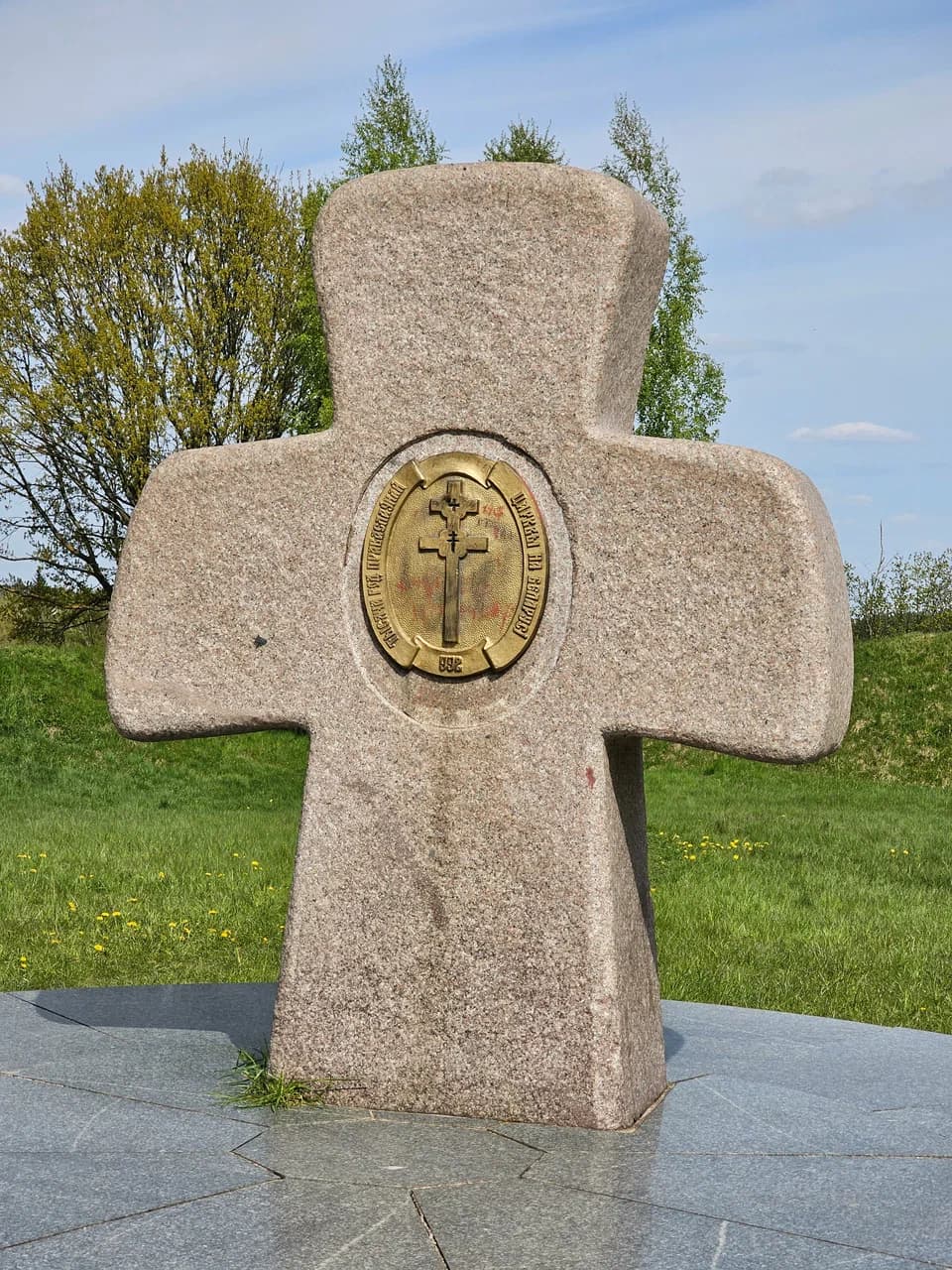
Today, "Zamechek" is part of the Zaslavl State Historical and Cultural Museum-Reserve and is under state protection. Only the circular earthen rampart has been preserved from the ancient fortifications. In 1992, in honor of the 1000th anniversary of the Polotsk diocese, a memorial sign in the form of a stone cross on a round pedestal was erected in the center of the settlement. This cross symbolizes not only the adoption of Christianity (according to legend, it was here that Rogneda and Izyaslav adopted the new faith), but also the memory of the dramatic events that began the history of ancient Izyaslavl.