
A Ruchitsa. Ruins of chapels.
Landmark
Ruchitsa village, Narochansky village council, Vileysky district, Minsk region
-1785433410982.webp&w=3840&q=75)
-1785433410946.webp&w=3840&q=75)
-1785433410942.webp&w=3840&q=75)
Description
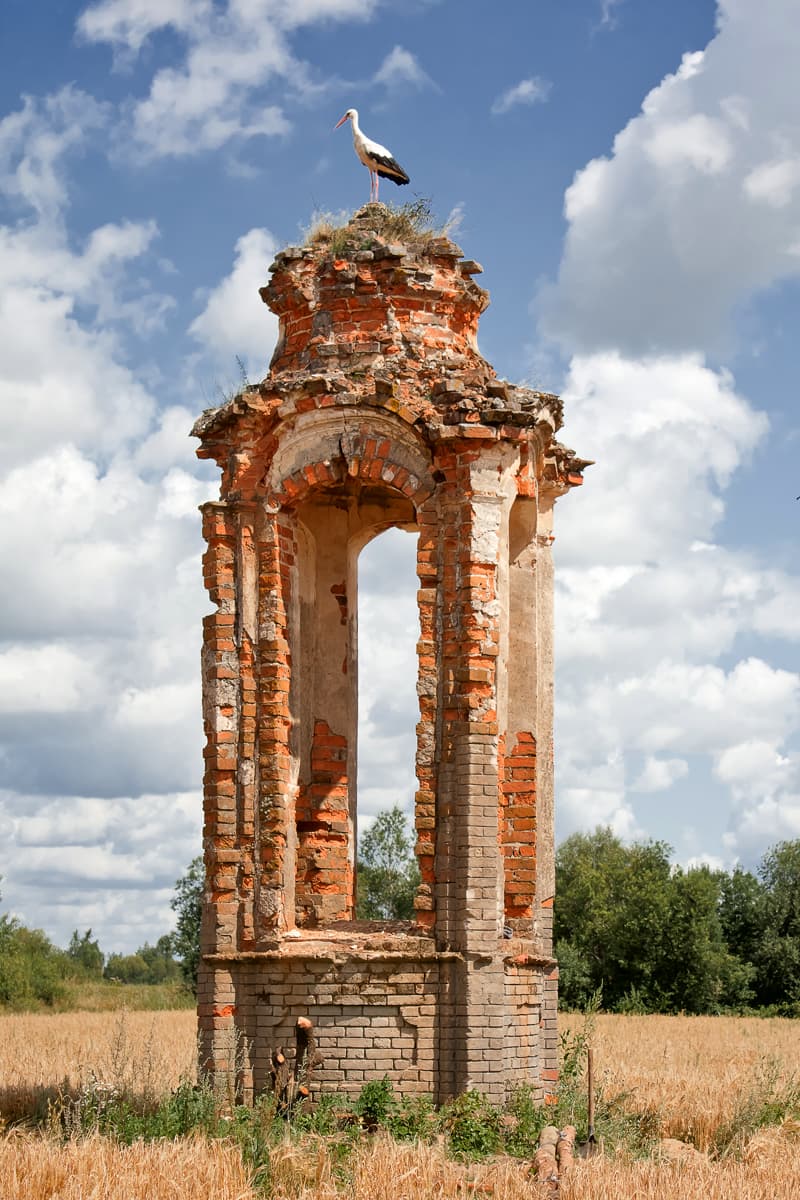
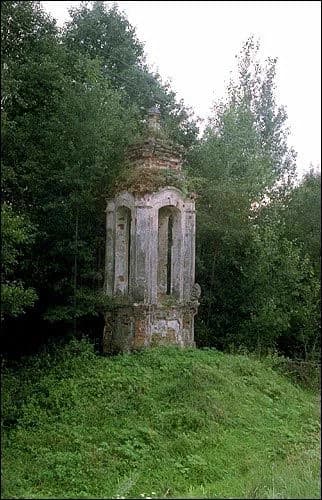
In the village of Ruchitsa, the ruins of two Baroque chapels have been preserved - silent witnesses to the former greatness of the Oginsky estate "Ganuta".
Built in 1765 by the Italian architect Abraham Genu, they became part of a magnificent estate known since the 16th century. One can be seen at the dam opposite the church, the other in the middle of a field near the cemetery.
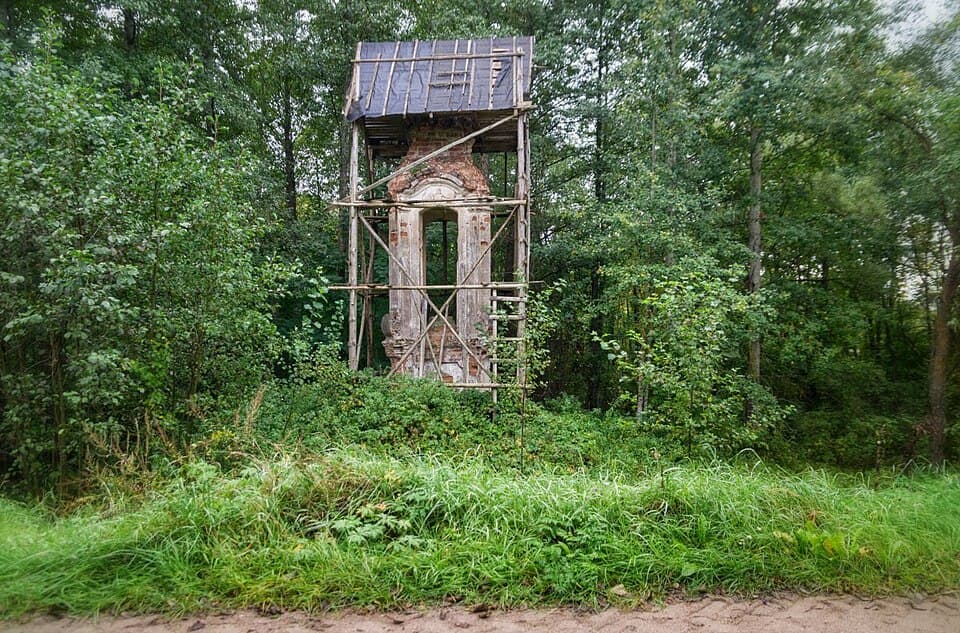
For many years, the architectural monuments fell into disrepair. In the fall of 2020, one of the pillars of one of the chapels collapsed, and only then did the authorities pay attention to them.
Today, the preserved chapel is gradually coming to life: in 2024, enthusiasts from the public association of restorers began its restoration, bearing the costs.
Categories

Historical

Ruins

Architectural monument

On restoration
Comments
Reviews to the Place
1Ольга Ерёменко
30.07.2026
Ruins of chapels of the manor "Ganuta".
In the village of Ruchitsa, Vileika district, lost among the fields and forests of Minsk region, time seemed to stop. Here, half a kilometer from the modern village, are the ruins of two Baroque chapels - the last silent witnesses of the former greatness of the Oginsky estate "Ganuta". This place is steeped in history, music and tragedy, and its monuments have survived decades of neglect.
The Ganuta estate (the historical name of Ruchitsa) has been known since the beginning of the 16th century. However, it experienced its finest hour in the second half of the XVIII century, when Tadeusz Oginsky invited the Italian architect Abraham Genu. In 1765, a majestic late Baroque palace and park complex with Rococo elements was erected here. The real gem of the estate are two elegant chapels, crowned with Baroque domes, inside which there were once sculptures of saints.
In 1814, the estate was inherited by the famous composer and diplomat Michal Kleofas Oginsky, the author of the polonaise "Farewell to the Motherland". There is a legend that it was here, in Ganuta, that he created this soulful work. Later, the estate passed to the Voloviches, and then to the Rzheutskys, who owned it until the beginning of the 20th century.
The First World War caused serious damage to the estate, but they were still trying to restore it. The final point in the history of Ganuta was set in 1943, when the estate was completely destroyed. There is no trace of the magnificent palace - today there is only an overgrown hill in its place.
For many decades, the two chapels stood in a dilapidated state, gradually losing their historical appearance. Local activists and local historians have repeatedly sounded the alarm, warning of the threat of a complete collapse, but officials have not responded to their calls for a long time.
The tragedy occurred in the fall of 2020 - one of the pillars of the chapel of the XVIII century collapsed. Only after that, the authorities took real steps to preserve the monuments. In 2021, security zones were developed that did not exist before. In January 2023, the remains of the estate, including a pond, two chapels and a church, were officially included in the State List of Historical and Cultural Values of Belarus.
In 2024, the Republican Public Association of Restorers, headed by Mikhail Zhikh, began restoring the preserved chapel at its own expense. The project was developed by restorer Alexander Vashkevich at the "Belzhilproekt" Institute. By the 260th anniversary of the birth of Michal Kleofas Oginsky, the work was completed.
However, the long-awaited opening of the restored chapel in September 2025 caused a mixed reaction among heritage experts: the quality of the restoration was sharply criticized, noting that the detailing was very rough and did not comply with the principles of scientific restoration. In particular, they were criticized:
· The shape of the Baroque helmet: the proportions have changed, the characteristic bulge has disappeared, and alien elements have appeared.
· Cornices: instead of complex order profiles, we made several rough "steps".
The authors emphasized that not only the preserved historical photographs could be used as a guide during the restoration, but also an identical second chapel. Poor-quality restoration, in their opinion, is sometimes worse than outright destruction, since it has not yet been necessary to correct such mistakes in Belarusian practice.
Despite the controversial completion of the restoration, the place remains attractive to travelers and historians. Today in Ruchitsa you can see:
· The restored chapel (at the dam opposite the church);
· Ruins of the second chapel (in the middle of a field near the cemetery) ;
· The current Assumption Church, built in the second half of the 19th century ;
· The remains of the distillery and the mill.
The churchyard contains the military burial of two Siberian Cossacks who were martyred on September 6, 1915 during the battles of the First World War. Their names were established only a century later thanks to the painstaking work of local historians.
Not far from Ruchitsa (about 500 meters) there is a suspension bridge over the river leading to the neighboring village of Krasnitsa, a popular place for photo shoots.
Coordinates of the Assumption Church (for reference): 54°27'21.21" north latitude (54.455891), 26°40'08.14" east longitude (26.668928).
Coordinates of one of the chapels (at the dam): 54°27'31.70", 26°39'54.26".
Ruchitsa is a place where history, art and human destinies are intertwined in a bizarre pattern, reminding us of the fragility of cultural heritage and the importance of its preservation for future generations.