
Minsk. The Tsanava Tower.
Landmark
Minsk, Independence Avenue, 17
Description
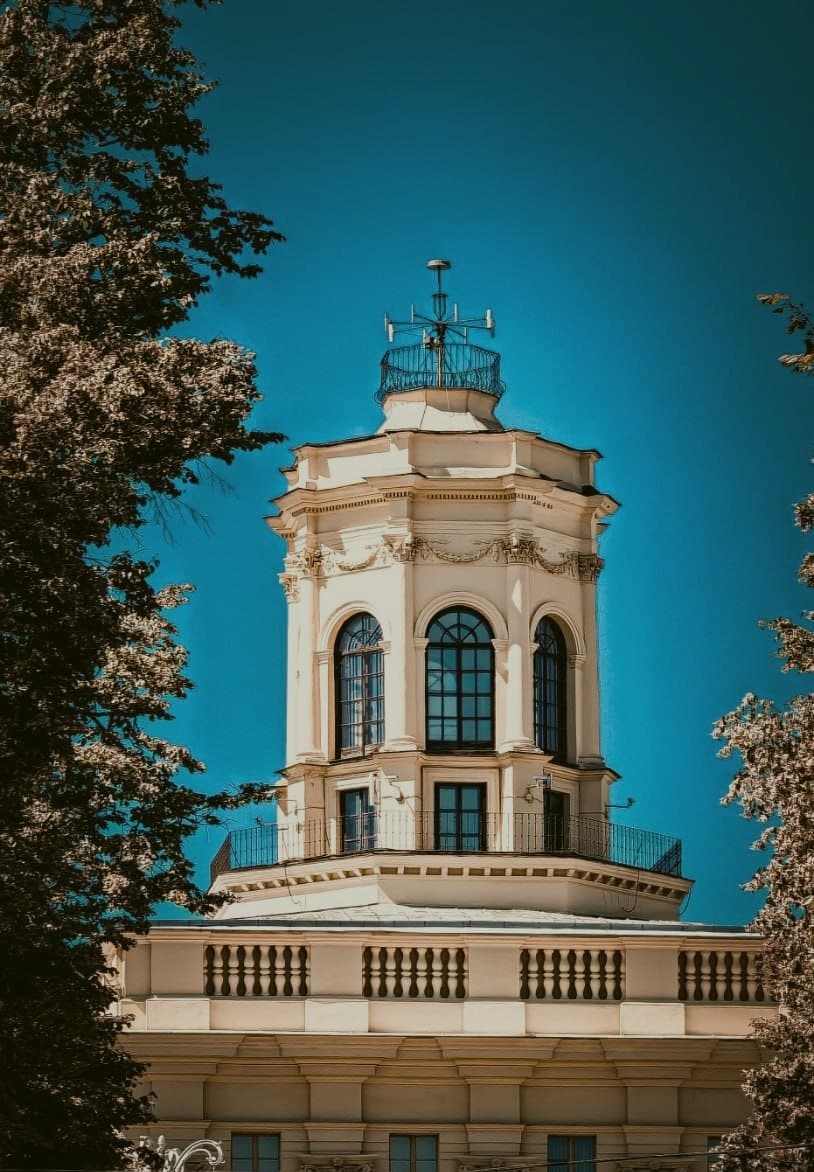
Why does the KGB building in Minsk stand asymmetrically? It's all about the whim of the all-powerful People's Commissar Lavrenty Tsanava. In 1945, he pointed a pencil at the blueprint and ordered the tower to be built where it was not planned. The architects had no choice but to obey the "law of Tsanava". We tell you how a trophy watch from Konigsberg appeared on a neighboring house, why the people's commissar was not allowed into his own turret, and what football has to do with it. The story of an architectural mistake that has become a legend.
Categories

Historical

Architectural monument
Comments
Reviews to the Place
1Ольга Ерёменко
17.03.2026
The mystery of the Minsk "Turret": why does the KGB building look asymmetrical and what does football have to do with it
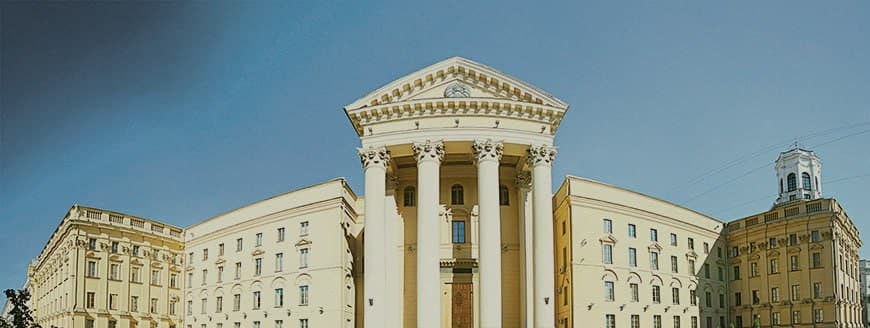
If you look at the central part of Minsk from a bird's-eye view, one architectural inconsistency catches your eye. The majestic Independence Avenue is lined with buildings in the Stalinist Empire style, where strict symmetry reigns. But at the corner with Komsomolskaya Street, this order is violated by a bold vertical accent - the famous "Tsanava Tower" crowning the House of State Security (Independence Avenue, 17).
It's not just a decorative element. It is a monument to human tyranny, architectural compromise and one of the most intriguing legends of post-war Minsk.
"Tsanava's law is in force in Belarus".
The history of the tower began in 1945, when Minsk lay in ruins and plans for its restoration were actively being developed. Architect Mikhail Parusnikov and his colleague Vladimir Korol have prepared a project of a magnificent building for the NKGB (People's Commissariat of State Security). The building was supposed to become part of the ceremonial ensemble of the avenue, perfectly fitting into the building line. It was planned that it would be strict, symmetrical, perhaps with a tall spire, but in the central part.
Korol went to the first person, Lavrenty Fomich Tsanava, People's Commissar of Internal Affairs and State Security of the BSSR, to coordinate the project. A man whose power in the republic was almost limitless. Legend has it that Tsanava studied the drawings skeptically for a long time. And then he suddenly pointed with a pencil at an empty corner of the building facing the intersection, and briefly said:
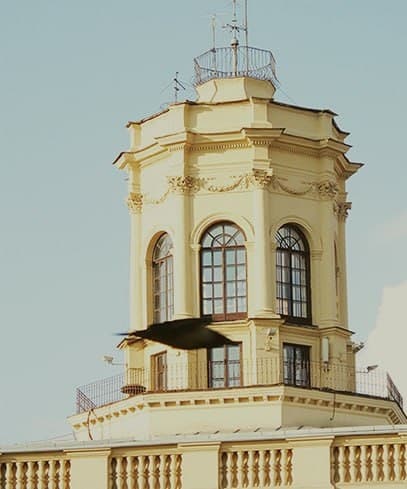
— And there will be a turret here.
The architect tried to object, referring to the laws of harmony and symmetry, that the tower would violate the integrity of the ensemble. But Tsanava interrupted him with a phrase that became famous: "There is only one law in Belarus - Tsanava's law".
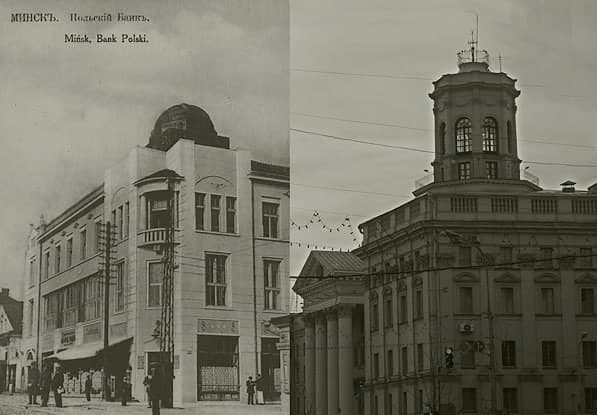
Arguing with the People's Commissar, whose signature could be sent to the basements of the Lubyanka, was like death. The architects had to hastily redesign the project. The tower was built into a corner, but the original idea (to install a tall spire on it) was later abandoned. As a result, the tower turned out to be squat, but very expressive and immediately became a visual dominant. The building was partially built on the surviving foundation and walls of the pre-war GUM store (a former Polish bank), which also once had a turret. So, perhaps, the whim of the People's commissar only resurrected the old composition.
Watches for subordinates and a football myth.
Tsanava was generally a big-shot man. He settled with his elite in a neighboring house (Independence Avenue, 19), which is also crowned by a tower. Only it has a huge clock on it. According to legend, passers-by constantly harassed the state security officers with the question "What time is it?". They complained to their superiors. And Tsanava, tired of these interruptions, ordered an accurate city clock to be hung on the tower of an apartment building so that no one would distract his people from their work anymore.
The watch mechanism was brought from the defeated Konigsberg (now Kaliningrad) as a trophy. The dials were painted black by personal order of the People's Commissar. They say that Lavrenty Fomich himself checked his wristwatch against them every morning when leaving the entrance. By the way, 20 years ago they tried to make the mechanism play a melody every 15 minutes, but the residents of the surrounding houses rebelled against such a "musical" neighborhood, and the fight was turned off.
As for the "Tsanava tower" on the KGB building itself, there are no less myths associated with it:
· Personal office? No. There is a very steep staircase inside the tower, and it would be difficult for an obese drug addict to climb there.
· Prison or observatory? No. The tower is hollow inside and is used more as a technical room.
· VIP football box? This is the most persistent myth. Allegedly, Tsanava, being an avid fan, wanted to watch the matches from the Dynamo stadium right from his office. Alas, the geography does not match: only the edge of the field and the stands are visible from the tower, and it is impossible to view the game from there.
The fate of the "master" of the tower.
Lavrenty Tsanava himself (his real name is Janjava) went from a simple chekist to an all-powerful people's commissar. A Georgian by nationality, a protégé of Lavrenty Beria, he led the Minsk basements during the years of terror and the guerrilla movement during the war. In post-war Minsk, he felt like a sovereign master, changing the appearance of the city at his discretion. It was during his lifetime that Lenin Square was paved, and prisoners of war built the future main avenue.
He had a separate "people's Commissariat" entrance to the building, where he arrived with pomp, exactly at 11 a.m. and exactly at 11 p.m. They say there was always a red carpet at the entrance.
But the "law of Tsanava" did not last long. After Stalin's death in 1953, the purge began. Beria was arrested, and with him his henchmen. Tsanava was removed from all posts, summoned to Moscow and arrested. He died in Butyrka prison of a heart attack (or, as it was whispered, from the "help" of fellow inmates) in the same 1953, without waiting for the trial.
Today, the Tsanava Tower is an integral part of the architectural code of Minsk. Passersby rarely think about the dark history of its creation, perceiving it as a beautiful detail of the avenue. And only local historians know that this corner of the building is not an architect's mistake, but the whim of a man who fancies himself above any laws except his own.