
The Rakov glacial conglomerate.
Natural site
Minsk region, Volozhinsky district
-1773041528940.webp&w=3840&q=75)
-1773041529004.webp&w=3840&q=75)
-1773041529103.webp&w=3840&q=75)
-1773041529062.webp&w=3840&q=75)
-1773041529395.webp&w=3840&q=75)
-1773041529076.webp&w=3840&q=75)
-1773041529116.webp&w=3840&q=75)
-1773041529488.webp&w=3840&q=75)
Description
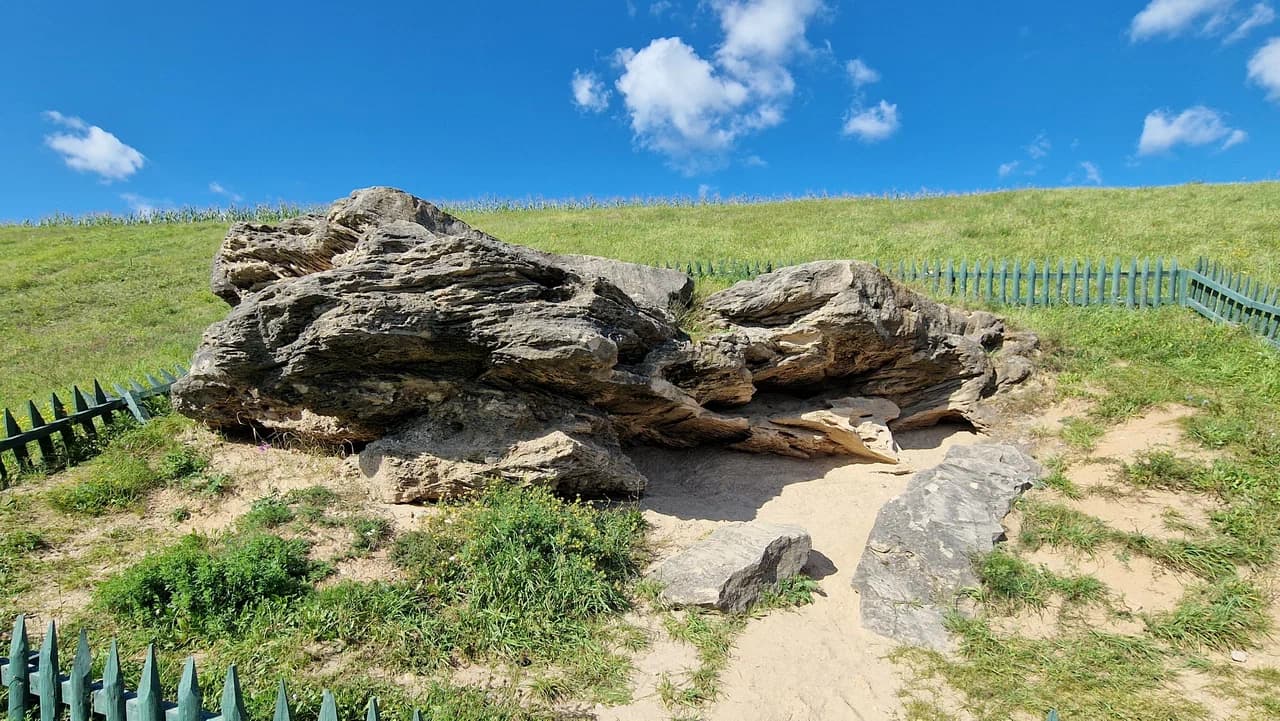
Just 35 km from Minsk, right off the highway to Grodno, there is a giant "stone alien" hiding. The Rakov glacial conglomerate is a 100-ton block that was brought to Belarus by the Scandinavian glacier 150,000 years ago.
Unlike ordinary boulders, the conglomerate looks like an ancient beach pressed into stone. It was accidentally found by the builders of the road in the XX century and did not destroy it. Today it is a geological natural monument where tourists make wishes and leave coins in the cracks of the giant. Scientists call it a time machine that allows you to look into the Ice Age, and travelers call it an ideal stop on the way to ancient Rakov.
Categories

Geological
Comments
Reviews to the Place
1Ольга Ерёменко
09.03.2026
Stone Alien from the Ice Age: the mystery of the Rakov Conglomerate
35 kilometers from Minsk, right on the side of the busy Minsk-Grodno highway, one of the most unusual and ancient monuments of Belarus is hidden. Locals simply call it "the stone by the road", but scientists have given it a name - the Rakov Glacial conglomerate. This giant, weighing about 100 tons, is a real time machine that allows you to touch the era when ice dominated the territory of modern Europe.
A witness to the ice Age.
Imagine this: 150-200 thousand years ago, the territory of Belarus was hidden under the powerful shell of a glacier advancing from the Scandinavian Mountains. Huge masses of ice were moving south, wiping out everything in their path and dragging rock fragments with them. That's how the future Rakov monument "arrived" in our region, in the thickness of the glacier.
Unlike ordinary boulders, which are often found in Belarus, the Rakov conglomerate is a unique geological formation. The word "conglomerate" means "lumped together". This block consists of pebbles, gravel and sand compressed by time, tremendous pressure and geophysical processes. In fact, this is an ancient beach or seabed that froze, compressed and turned into stone, and then was "transported" by a glacier to central Belarus. At that time, the edge of a glacier passed on the site of Rakov, which, retreating, left this "stone alien" here.
How the giant was found.
For thousands of years, the conglomerate has been hidden from human eyes, buried under layers of earth. It was discovered by chance only in the 20th century, when the construction of the Minsk-Grodno highway began. The bucket of the excavator hit something hard, and a giant block of sandstone appeared before the eyes of the road workers. The builders did not break up the unique find, but decided to preserve it.
Today, the stone is located on the northern slope of the right-of-way of the 35th kilometer of the highway. The part of it that we can see is just the tip of the iceberg. The width of the protruding part reaches 5 meters, and the height is 2.2 meters. In 1988, the conglomerate was declared a geological monument of nature, and in 2007 it received the status of national significance, which underlines its importance for the country's natural heritage.
A place of power with coins and legends.
Today, the Rakov Glacial conglomerate is not only an object of scientific interest to geologists. It is a popular tourist stop. It is difficult to miss it by the road: it is fenced with a low "cheerful" fence, which protects the monument from accidental damage by transport.
Almost all travelers who stay here have a tradition of making a wish and leaving a coin in the cracks of an ancient stone. Looking at this centuries-old block, one involuntarily feels respect for the forces of nature. Standing next to it, you can fantasize about what our planet looked like when endless icy deserts stretched here, where cars are now making noise, and this boulder was just starting its long journey from Scandinavia.
Part of a big journey.
The Rakov conglomerate will be a great place to explore the village of Rakov itself, which is just a couple of kilometers away. This place is famous for its rich history. The Church of the Transfiguration of the Savior, the Church of the Virgin Mary, the ancient settlement and the ancient Jewish necropolis have been preserved here. Rakov is called a "place of inspiration" - writer Eliza Ozheshko and composer Michal Grushvitsky lived here.
If you are traveling in the Minsk region, be sure to set aside half an hour for this stop. The glacial conglomerate is a unique reminder that the history of the Earth is measured not in centuries, but in millennia, and part of this history can be seen with your own eyes right by the side of the road.