
Korma. Doria-Dernolovich manor complex Stefanovo-Sarsk.
Manor
Korma, Zavodskaya Street, 16
-1772534235985.webp&w=3840&q=75)
-1772534236029.webp&w=3840&q=75)
-1772534236072.webp&w=3840&q=75)
-1772534236047.webp&w=3840&q=75)
-1772534236110.webp&w=3840&q=75)
-1772534236090.webp&w=3840&q=75)
-1772534236487.webp&w=3840&q=75)
-1772534243833.webp&w=3840&q=75)
-1772534243877.webp&w=3840&q=75)
Description
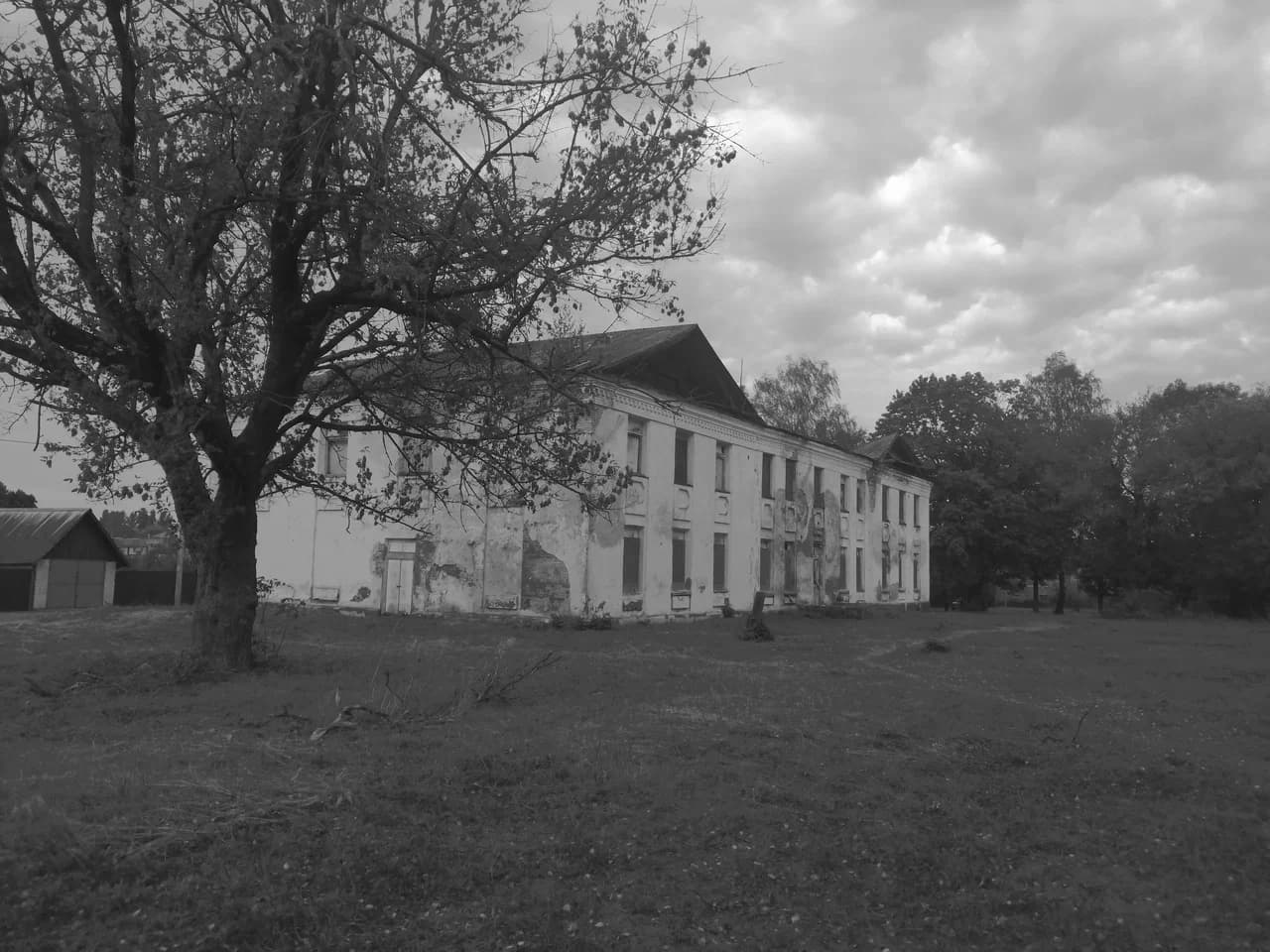
On the high bank of the Sozh River in the urban village of Korma, there is a unique monument of manor-industrial architecture - the former estate of the Doria-Dernolovich noble family. Built at the end of the 19th century, this complex combined an elegant manor house with a portico and advanced production at that time: starch and alcohol factories, the equipment for which was purchased in Europe. After the revolution, the estate was saved from destruction by an orphanage and a school, and the factory operated until 1996. Today, the abandoned manor, preserving the spirit of history and the former industrial scale, is waiting for its revival.
Categories

Ruins

Architectural monument

Park area

Historical
Comments
Reviews to the Place
1Ольга Ерёменко
03.03.2026
The forgotten pearl above Sozh: Doria-Dernolovich manor complex in Korma.
In the north-east of Gomel region, in the urban settlement of Korma, a monument of manor and park architecture of the turn of the XIX-XX centuries is hidden from prying eyes. This is the former estate of the Doria-Dernolovich noble family (coat of arms "Lyubich") - the only one of their possessions in Belarus that has survived to this day.
The history of the estate began with a dynastic marriage: the daughter of local landowner Bykovsky, to whom Korma had belonged since 1565, married a representative of the Doria-Dernolovich family. It was he who decided to build his own residence on the outskirts of the village. At the end of the 19th century, the Stefanovo-Sarsk estate (according to some sources, named after Stefan Dernolovich) passed to Alexander Dernolovich, under whom the complex reached its heyday.
The architectural dominant of the ensemble is a two-storey manor house made of brick. Its main facade is decorated with a stylized portico of eight semi-columns and symmetrical side risalites. The central part of the building is accentuated by the decoration with lunettes above the windows. Unlike many noble nests, which served only for living, the estate in Korma was a multifunctional industrial complex. In addition to the manor house, it included a grain mill, a water mill with an oil engine and a park. In 1905, a starch factory was built here, and in 1912-1914 it was converted into a distillery, purchasing equipment from Europe.
The fate of the estate after the 1917 revolution is typical, but only partially. The property was nationalized, but the complex was not abandoned: the industrial buildings continued to be used for their intended purpose. The equipment purchased under the Dernolovich family worked for almost 80 years, until the distillery was closed in 1996. The manor house was saved by social functions after the war: until 1955 there was an orphanage, then a secondary school. Unfortunately, the building was later adapted for warehouses, which did not contribute to the preservation of the interiors.
Today, the former Doria-Dernolovich estate complex is not only a two-story mansion, but also the ruins of industrial workshops, fragments of a park and the coastal area of a local reservoir. All this, together with the surrounding area, occupies about two hectares. The ensemble is a living witness to the economic power of the pre-revolutionary latifundia and an example of how a pragmatic approach to heritage in Soviet times (one hundred percent use of buildings) allowed us to bring to us a unique industrial-type noble estate. Despite the status of historical and cultural value and repeated calls for restoration, the complex is gradually decaying, awaiting a new owner or investor who will give it a second life.