
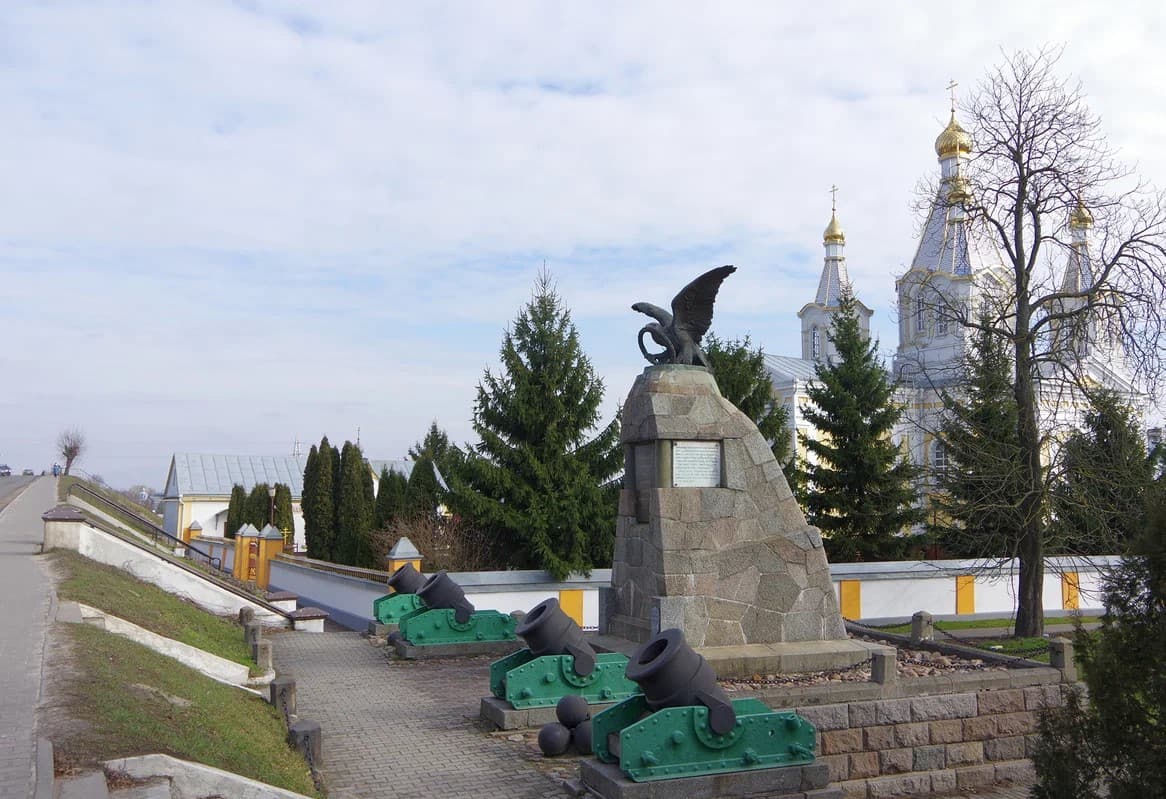
Kobrin. Monument in honor of the victory in the war of 1812.
Landmark
Republic of Belarus, Brest region, Kobrin, Lenin St., 18
-1783862804267.jpg&w=3840&q=75)
-1783862804318.jpg&w=3840&q=75)
-1783862804356.jpg&w=3840&q=75)
-1783862804180.jpg&w=3840&q=75)
-1783862804230.jpg&w=3840&q=75)
-1783862804382.jpg&w=3840&q=75)
-1783862804800.jpg&w=3840&q=75)
-1783862804865.jpg&w=3840&q=75)
-1783862804955.jpg&w=3840&q=75)
Description
The memory of the first significant victory of the Russian troops over Napoleon in 1812 is perpetuated in Kobrin. The central place is occupied by the Alexander Nevsky Cathedral, erected in 1864-1868 on the site of the mass grave of soldiers who died in battle on July 15, 1812. There is a memorial plaque on its wall in honor of that victory.
In 1913, a magnificent monument was unveiled next to the cathedral at the expense of military personnel and residents. Initially, it was a granite rock with a bronze double-headed eagle symbolically tearing the laurel wreath of Napoleon. The monument suffered losses: its details were removed during the First World War, and later a bust of Tadeusz Kosciuszko and a Soviet single-headed eagle appeared on the pedestal. In 1951, the monument was restored with memorial plaques listing the regiments participating in the battle and reading: "To the Russian soldiers who won the first victory over Napoleon's troops within Russia".
Categories

Historical
Comments
Reviews to the Place
1Ольга Ерёменко
12.07.2026
Memory of the first victory: Kobrin memorial of the war of 1812.
In Kobrin, on quiet Lenin Street, by the Mukhavets River, stands the majestic Alexander Nevsky Cathedral. Next to it is a monument whose history is inextricably linked with the dramatic events of the Patriotic War of 1812. This place preserves the memory of the first significant victory of the Russian troops over the Napoleonic army in the territory of the Russian Empire.
The battle that changed the course of the war
On July 15, 1812, troops of the 3rd Western Army under the command of cavalry General Alexander Petrovich Tormasov and the Saxon corps of General Jean Rainier converged at Kobrin. Kobrin's garrison, commanded by Saxon Major General Klengel, numbered about 4,000 people. The Russian troops, approaching the city from several sides, launched an assault that lasted more than nine hours.
The outcome of the battle was a triumph for Russian weapons. The Saxon detachment was completely defeated: General Klengel, 3 colonels, 59 officers and about 2,380 soldiers were captured. 8 guns and 4 banners were captured. The losses on the Russian side turned out to be incomparably lower - 74 killed and 181 wounded. The news of the victory instantly spread around the country - in honor of her, a victory salute was heard for the first time from the walls of the Peter and Paul Fortress in St. Petersburg.
Memorial church on a mass grave
The memory of the fallen heroes was perpetuated after half a century. Russians grave of Alexander Nevsky Cathedral was built in 1864-1868 on the site of the mass grave of Russian soldiers. The temple was built not only in honor of the victory of 1812, but also as a monument to the liberation of peasants from serfdom. It was built at the expense of the peasants of the Kobrin district and with the support of Count Mikhail Muravyov. Today, the cathedral, designed in the style of late classicism with elements of the Russian style, is a monument of architecture and history, and a memorial plaque in honor of that distant victory is installed on its wall.
A monument with a difficult fate
In 1912, on the centenary of the event, a monument to Russian soldiers was laid next to the cathedral. Soldiers and officers of the 38th Infantry Division and ordinary residents raised funds for it. The opening took place in July 1913. The monument was a granite rock topped with a bronze double-headed eagle tearing a laurel wreath with the monogram of Napoleon, a symbol of the invincibility of the French emperor. Three marble plaques with the names of the participating regiments, the number of trophies and the names of donors were fixed on the pedestal.
However, the monument stood in its original form for only two years. In 1915, after the occupation of Kobrin by German troops, the eagle and memorial plaques were dismantled and removed. During the Polish period, a bust of Tadeusz Kosciuszko was installed on an empty pedestal. It was only in 1951 that the monument was restored - this time it was crowned with a single-headed eagle, and memorial plaques with restored texts reappeared on the sides.
Today, both the cathedral and the monument form a single memorial complex - a symbol of the courage of the Russian soldiers who won the first victory over Napoleon's army.