
Gomel. Boguslavsky Estate and Park complex.
Manor
Gomel, Lepeshinsky St., 9
-1785579912033.webp&w=3840&q=75)
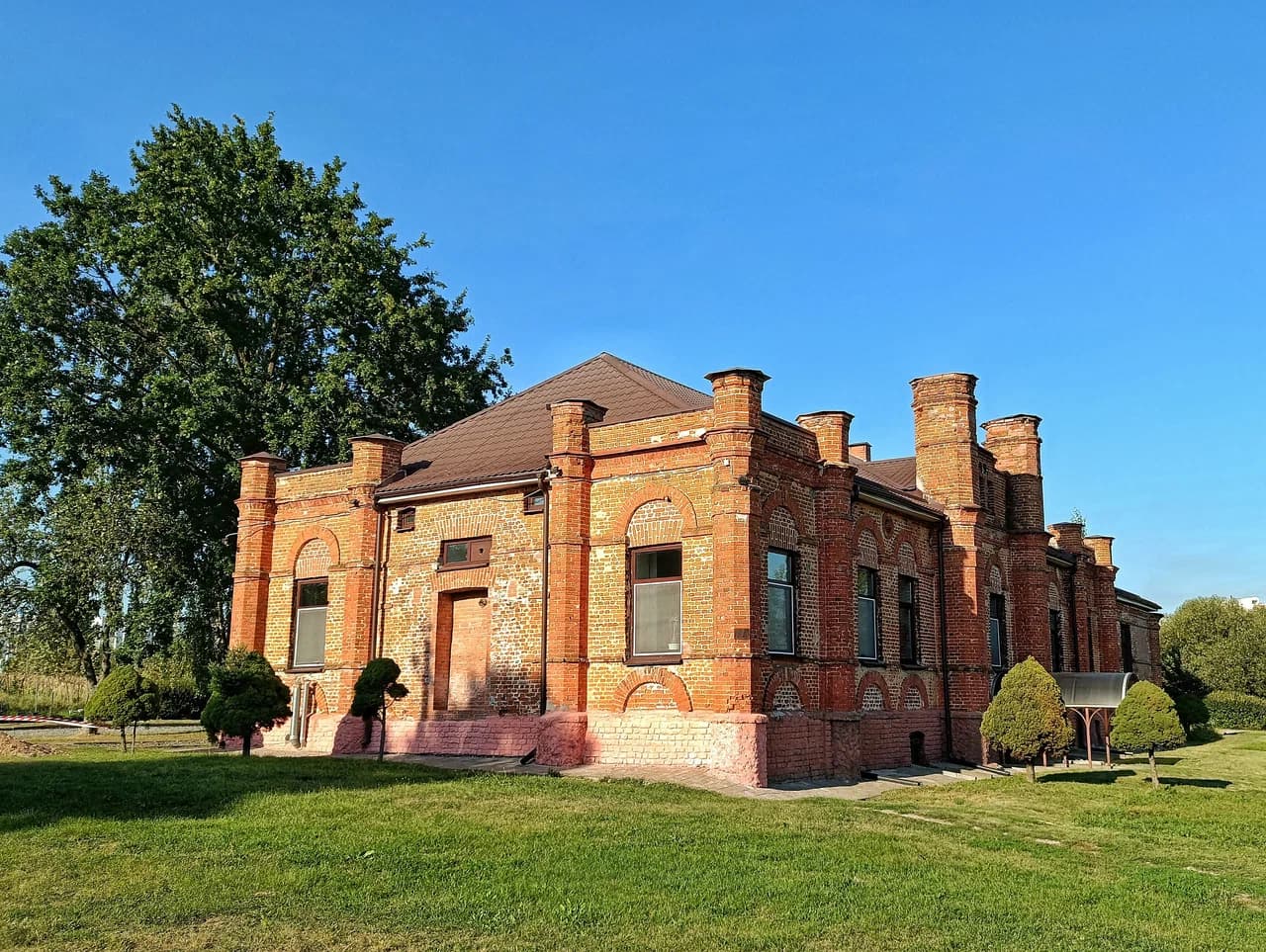
-1785579913128.webp&w=3840&q=75)
-1785579912093.webp&w=3840&q=75)
-1785579912079.webp&w=3840&q=75)
-1785579912408.webp&w=3840&q=75)
-1785579912442.webp&w=3840&q=75)
-1785579913018.webp&w=3840&q=75)
-1785579913306.webp&w=3840&q=75)
-1785579913190.webp&w=3840&q=75)
Description
Another architectural gem of Gomel is the Boguslavsky Manor and Park complex, or Boguslavsky farmstead. This landmark is not known to everyone, but here you can see rare examples of outbuildings of the 19th century.
The history of the complex goes back to the 18th century, when these lands belonged to Count Rumyantsev. The estate flourished in 1838-1849, and later ownership passed to the Paskevich family. The ensemble was impressive in its scope: there was a stable with a riding arena, a winery, an ice house, kitchen buildings and a picturesque park with a cascade of ponds.
Today, several buildings have been preserved from their former greatness. Special attention should be paid to the 1849 winery building with an elegant colonnade, which is the only facility in the complex with a protected status. It currently houses the National Olympic Committee representative office. Nearby there is a late 18th century mace-shaped stable with arena and a 1911 barn in a pseudo-Gothic style.
Categories

Park area

Architectural monument

Exposition

Historical
Comments
Reviews to the Place
2Murphy Darkwalker
02.08.2026
Boguslavsky Farmstead: The architectural heritage of Count Rumyantsev and the living history of Gomel.
In the shadow of the main sights of Gomel, there is a place with a special character — the Boguslavsky Farmstead. This is a rare example of a perfectly preserved estate and economic complex in southern Belarus, where the utilitarianism of agricultural production in the 19th century was intertwined with a high architectural style. Where once the life of the count's economy was in full swing, today athletic grace and the spirit of noble antiquity harmoniously coexist.
Count Rumyantsev's legacy: from the manor house to exemplary economy
The history of the location dates back to the 18th century, when there was a small manor house on this site. A new stage of development began in the first half of the 19th century under the patronage of the statesman and philanthropist Count Nikolai Petrovich Rumyantsev. On his instructions, the Boguslavsky economy was created here — the main administrative and economic center of the district.
Already on the plans of Gomel in 1838, the folwark is clearly marked as a formed object. By 1849, the construction of the main ensemble was completed. The farm was large-scale and balanced: animal husbandry, beekeeping, horse breeding and processing of raw materials were successfully developed here.
After the revolution, the farm was transferred to the people's government, and in the 1920s, a stud farm was established on its basis. It was the continuous economic use that saved the ancient buildings from destruction and desolation.
Architectural structure: facts and details
The manor ensemble is interesting with a thoughtful combination of red unpainted bricks, elements of pseudo-Gothic and national architecture. All the surviving buildings are single-storied, but they are impressive for their strength and wall thickness.
- Stable with a semicircular arena (late 18th century): The oldest building of the complex. The architect applied a non-standard spatial solution: the rounded part of the dressage arena adjoins the rectangular body of the stable. The facades are plastered, separated by niches, window openings and cornices. Later, an additional room was added on the south side.
- The winery (1849): A monument of brick architecture with a hip roof. The main entrance is decorated with a two-column portico with a pediment and a staircase. The facades are decorated with pilasters, sandricks, round windows-lucarns and figured attics. Below is a deep basement with windows now sealed up, where products were previously stored.
- Brick barn and T-shaped stable (early 20th century): Buildings with gable roofs. Their walls are decorated with arched friezes, rusticated shoulder blades, rectangular windows with keystones and ornate end shields.
- Economic services (mid-19th century): A kitchen building, an ice cellar for storing food, and deep basements for workers have survived on the territory.
- Manor Park: Once the farm was surrounded by a park with flower beds, walking alleys, ponds and bridges. Today, only isolated fragments of plantings have been preserved from it.
What to watch today?
The Boguslavsky Estate is not just an open-air museum, but an active urban cluster.:
- NOC Representative Office: The renovated winery building houses the representative office of the National Olympic Committee for the Gomel Region.
- Equestrian School: The historical stables continue to serve their original purpose. The complex has a regional riding school with about 80 horses, a racetrack and the only indoor arena in Belarus in a modern annex.
- Brick decor: Architecture lovers can take a closer look at the workshop's curly masonry, thick walls and pseudo-Gothic elements of the buildings.
Bottom line: is it worth going?
The Boguslavsky Farmstead is worth a visit in order to:
- to see a rare example of the preserved noble economy of the 19th century;
- appreciate the original architecture of the stable with a riding arena and the brick decor of the winery;
- combine a tour of the historical site with a horse ride.
How to get there?
- Address: Gomel, Lepeshinsky str., 9.
- By car/public transport: The complex is located in the city limits of Gomel. You can get there by city buses and minibuses following Lepeshinsky Street.
Tips from the author
- Horseback riding: If you want not only to see the buildings, but also to ride horses or attend an equestrian lesson, it is better to contact the equestrian school in advance.
- Masonry details: Pay attention to the walls of the winery and barn: the brick decor with intricate arches and cornices is made without the use of plaster and is perfectly preserved.
- Route planning: It is convenient to combine a visit to the folvarka with an overview of other monuments of Gomel or include it in a weekend tour of Gomel region. Before the visit, it is necessary to clarify the accessibility of individual internal territories.
Ольга Ерёменко
01.08.2026
Gomel Boguslavsky farmstead: architectural chronicle in the shadow of the palace.
In Gomel, in the shadow of the famous Rumyantsev-Paskevich Palace, there is another historical gem - the Boguslavsky Estate and Park complex, or Boguslavsky farmstead. Unlike the grand palace, this manor has always been the working, economic heart of a huge estate. Today it is one of the few well-preserved examples of 19th-century manor and economic architecture in Belarus, where life is still in full swing.
The history of this place begins long before the appearance of the first stone buildings. The lands on which the folvark is located were part of the possessions of Count Nikolai Petrovich Rumyantsev. It was during his time that one of the economies was organized here - Boguslavskaya, which became the administrative and economic center of the district.
For the first time, the Boguslavsky farmstead appears on the plan of the Gomel neighborhood in 1838, although it is assumed that a small estate existed here as early as the XVIII century. After Rumyantsev's death, the complex passed into the possession of the Paskevich family, who owned it until the 1917 revolution. The active construction that shaped the appearance of the estate took place in 1849.
After the revolution, in the 1920s, a stud farm was established on the territory of the former farm, which largely determined its future fate. The buildings continued to be used for their intended purpose, which helped them to survive to this day. Today, the Gomel Regional Center of the Olympic Reserve for Applied Sports is located here, and equestrian traditions have not been interrupted for almost a century.
The main value of the complex is its preserved buildings, each of which is an architectural monument. In total, there are nine facilities on the territory of the folwark, built at different times - from the end of the XVIII to the beginning of the XX century. Let's focus on the most significant ones.
Winery (1849)
This is perhaps the most recognizable and elegant building in the complex. A one-story rectangular brick building with a basement. Its main entrance is decorated with an elegant two-column portico with a triangular pediment. The architectural decor is made in the technique of brickwork without plaster: pilasters, sandriks above the windows, round lucarns and figured attics create a rich, expressive appearance. Interestingly, the basement, where the finished products were stored, has been preserved, but its windows are sealed up today. Currently, the representative office of the National Olympic Committee of the Republic of Belarus for the Gomel region is located in the winery building.
Stable with arena (late 18th century)
The stable building with the arena is an example of a complex spatial solution. It consists of a rectangular stable and a rounded riding arena adjacent to it. It is one of the oldest surviving buildings in the complex. Its plastered facades are rhythmically divided by window openings located in niches. The building is still used for its intended purpose and belongs to the equestrian sports school.
Stables (early 20th century)
These buildings, built later, demonstrate a different architectural approach. They are made in brick style without plaster, with rich brickwork decoration. The facades are decorated with rusticated shoulder blades, arched friezes and cornices.
The history of the construction of one of these stables is interesting. For a long time it was believed that it was erected at the end of the XVIII century, but research conducted during the recent reconstruction proved that the building appeared later. On the estate plans of 1862 and 1874, a wooden house is marked in this place, and during the restoration, the date "1911" was found scratched into the brick in the wall of the neighboring stable. The bricks for the construction were supplied by the "N.Chernin. Volotova" factory, which worked at the beginning of the 20th century. Thus, the architectural chronicle of the farmstead continues to be refined.
Park and water system
The Boguslavsky Estate was not just a complex of outbuildings. An important part of it was a landscape park with a cascade of ponds and a lime alley, which served as a real decoration of the estate. Part of the park is now a public use area, and its picturesque corners are accessible for walking.
The Boguslavsky Manor and Park complex is a living story. Despite the fact that until recently only one building (the winery) had the official status of historical and cultural value, the entire ensemble is of great interest to researchers and tourists. Today, the situation is changing for the better.
In January 2026, after a large-scale reconstruction, an updated stable was opened at the beginning of the 20th century. In the course of the work carried out with maximum preservation of the authentic appearance, interesting artifacts were discovered, for example, fragments of unique tiles from the Paskevich years.
Local authorities and enthusiasts are actively discussing the prospects of including the farmstead in the tourist infrastructure of Gomel. The unique atmosphere and architectural expressiveness of the complex open up great potential for cultural events and the development of outdoor sports initiatives. This architectural "hidden gem" of Gomel is finally starting to receive well-deserved attention, and it is hoped that soon it will become no less a popular attraction than the famous palace.