
Babtsy. Tatar graves, stone crosses and an altar.
Landmark
Vitebsk region, Dokshitsky district, Babtsy village (Begomlsky village council)
Description
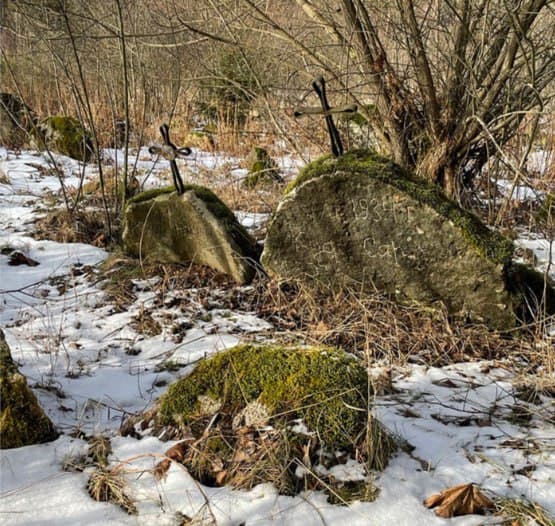
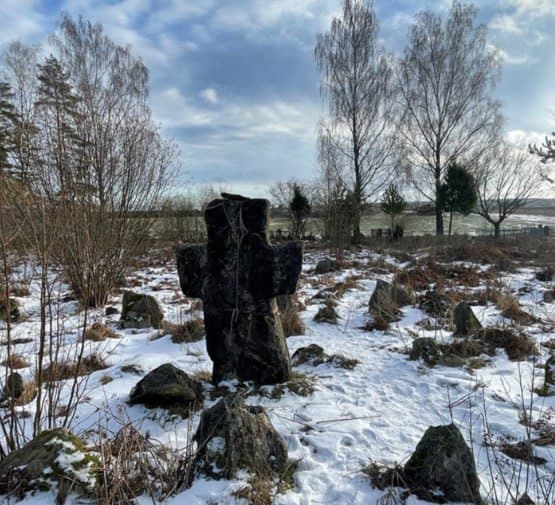
Three worlds have converged here on one patch of land: a pagan altar, ancient stone crosses and Tatar graves with crescents.
It is not known where these crosses came from. Some say these are medieval tombstones, others are the remains of a temple, and others were simply demolished during the construction of the cemetery. There are about thirty of them in total: from 30 cm to two meters tall.
It is better to go here in late winter or early autumn, as it is easier to see the signs on the stones that have been erased by time.
A mystical place where history does not provide answers, only questions.
Categories

Historical
Comments
Reviews to the Place
1Ольга Ерёменко
22.03.2026
A mystery at the junction of worlds. Why did Tatar graves, stone crosses and a pagan altar merge in one place?
There are places where time flows differently. Where the boundaries between eras are blurred, and history turns into a thick mystical cocktail. One of these places is an ancient village cemetery in the Dokshitsy district, near the village of Babtsy.
In 2011, local residents and local historians stumbled upon something that blew up their understanding of the region's past. Dozens of stone crosses suddenly appeared among the usual grasses and grave mounds. Where did they come from? Who installed them? And why are there three sacred traditions side by side here, on a relatively small piece of land: Muslim burials, ancient Orthodox (or Catholic?) crosses and, apparently, traces of a pagan temple?
Let's figure out this riddle that the earth has asked us.
Crosses that came out of nowhere.
The appearance of the stone crosses in 2011 was a real sensation for the locals. The villagers, accustomed to wooden monuments, looked with surprise at the massive stone blocks, roughly hewn in the shape of a cross. No one remembered them being installed here during their lifetime. Three main versions have emerged:
1. Medieval tombstones. According to this theory, crosses served as tombstones in the Middle Ages. Given the antiquity of this land, both the first Christians and representatives of noble families of the Grand Duchy of Lithuania could be buried here.
2. The pagan temple. Some researchers suggest that the place was originally sacred to the Baltic or Slavic tribes. Pagans could set up idols (altars) here, and later, with the advent of Christianity, "competing" symbols of faith - stone crosses - were erected in place of the former shrines to consecrate the land.
3. History dump. The most pragmatic version says that the crosses once stood alone throughout the area. In Soviet times, when religion was being fought and the territories were being gentrified, orphan ancient stones were simply bulldozed into one place, preparing a site for a new cemetery.
Interesting nuances: numbers, sizes and silence.
The complete lack of a clear documentary history adds to the mystery of this place. The exact date of the construction of the crosses has not yet been determined. To date, researchers have managed to discover about thirty such artifacts.
The range of sizes is amazing:
· The smallest ones barely reach 30 centimeters in height. Perhaps these are children's burials or symbolic votive crosses.
· Giants are taller than humans. Imagine a stone block two meters high, installed here hundreds, maybe thousands of years ago.
If you look closely, you can hardly guess the half-erased numbers and symbols on some of the stones. Time and the rains have done their job - it is almost impossible to read the inscriptions, but they are intriguing.
Travel advice: if you decide to go out, choose late winter or early autumn. There is no dense vegetation at this time of year, and the low sun provides sliding shadows that help to see what is hidden from view in the summer on the rocks.
Triangle of power: altar, cross and crescent.
The most amazing thing about Babtsy is not just the presence of ancient crosses. It is a synthesis of cultures.
A few steps from the stone crosses are the old Tatar graves. The Tatars, who settled on these lands back in the time of the Grand Duchy of Lithuania, traditionally installed stone tombstones with Arabic script and the image of a crescent moon on their graves. Their cemetery (mizar) here is adjacent to Christian symbols, which is a rare phenomenon for the Belarusian Polesie and Lake district, but historically possible.
But that's not all. Local historians and old-timers point out that there is some kind of altar or altar in the center of this "complex". A small elevation, a processed stone oriented to the cardinal directions - all this reveals traces of pre-Christian cults in this place.
It turns out to be a unique situation: a pagan altar, Christian crosses and Muslim burials coexist on one patch of land.
What's it? An accident? The tolerance of the ancestors, whose faith was a personal matter, and the sanctity of a place was determined not by religious affiliation, but by the power of the spirit? Or is it a place of power that people of different eras and faiths intuitively chose for the most important thing - to say goodbye to the departed and communicate with eternity?
While historians are arguing about dates, and archaeologists are dreaming of an excavation permit, this place remains one of the most controversial and atmospheric in Belarus. It is waiting for its researcher and its chronicler.